Home > Ryukyu Islands > Okinawa Main Islands
Situated at the northeastern end of the Ryukyu Archipelago, Okinawa is the largest island. Although it is long and narrow, extending approximately 100 km from north to south and 4–28 km from east to west, its irregular shape and topography are highly distinctive. The southern part consists mainly of relatively flat uplifted coral reef terraces, whereas the northern part is characterized by mountainous terrain, underlain by older geological formations and covered by the subtropical forests of Yanbaru.
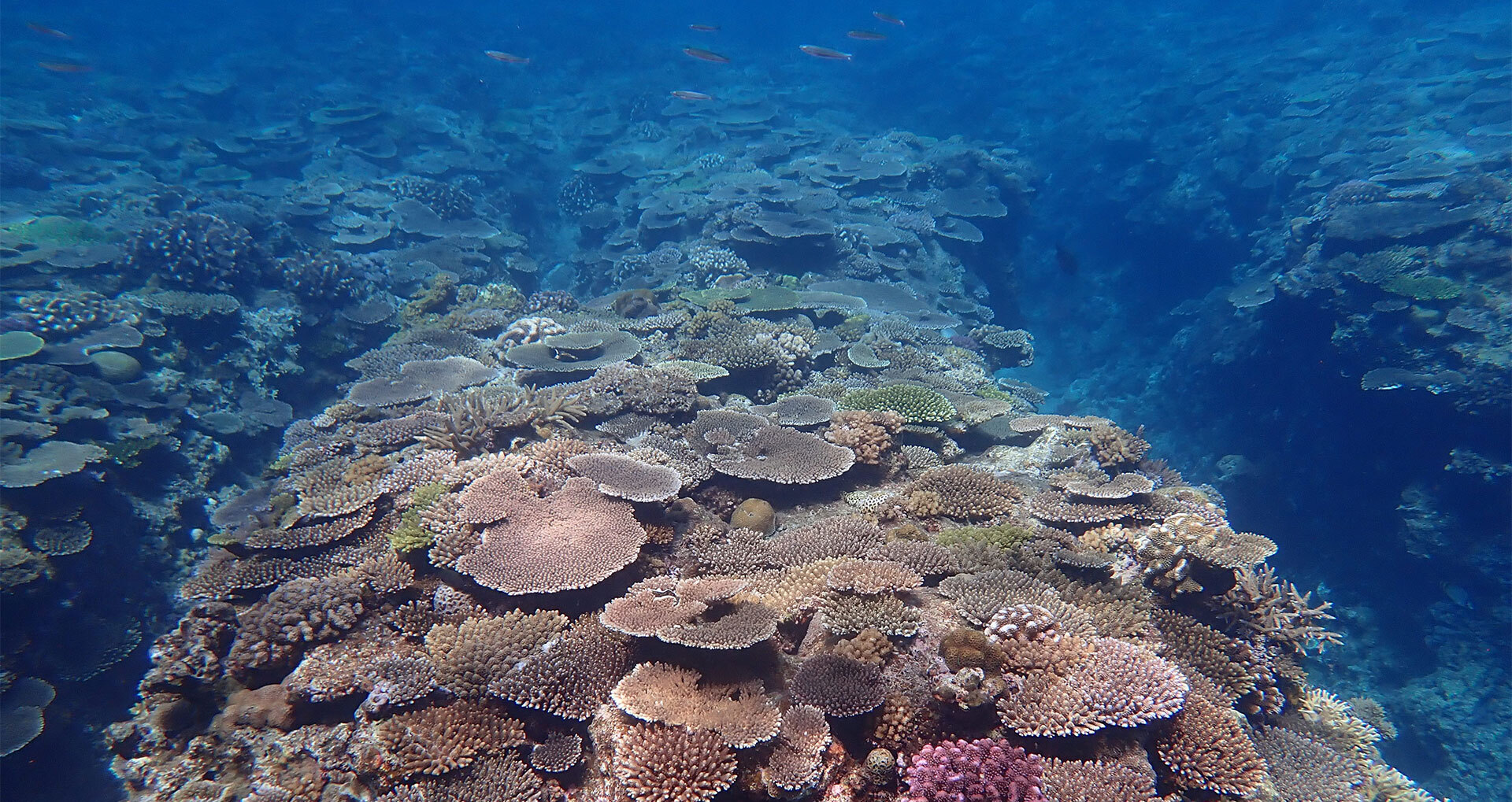
Coral reefs encircle the entire island. In particular, along the coast of Onna Village on the west coast, relatively calm oceanographic conditions have allowed extensive and spectacular growth of tabular and branching corals of the genus Acropora, making the area one of Okinawa’s premier destinations for coral reef tourism and observation. In addition, several surrounding islands, including Ie, Sesoko, Tsuken, and Kudaka Islands, contribute to the formation of complex coral reef ecosystems in the waters around Okinawa Island.
Since 2004, the Okinawa Environmental Science Center (OESC) has conducted coral reef monitoring surveys at 63 sites from the southern to the northern end of Okinawa Island, as part of the Ministry of the Environment Monitoring Sites 1000 Coral Reef Survey Project. These surveys have been carried out almost annually to document the distribution and condition of coral communities (see the Photo Collection section for more information about OESC). Building upon this long-term monitoring effort, OIST initiated coral environmental DNA metabarcoding (eDNA-M) surveys in 2021. Data presented here are based primarily on seawater samples collected during 2021 and 2022.
From the coast of Onna Village to the northern shores of Okinawa Island, a severe coral bleaching event occurred during the summer and autumn of 2024, mainly as a result of elevated sea surface temperatures. This event led to a large-scale decline of Acropora corals. Data presented here were collected before this bleaching event and therefore represent the condition of healthy coral reef communities prior to the disturbance. As such, they provide valuable baseline information for evaluating and understanding future reef recovery.
| Point Number | Point Name | Latitude/Longitude | Dominant Genus | Percentage |
|---|---|---|---|---|
| 1 |
Usahama east

|
26.8657, 128.2662 | Isopora (ニオウミドリイシ属) | 33.95 % |
| 2 |
Oku Port north
|
26.8491, 128.288 | Acropora (ミドリイシ属) | 62.99 % |
| 3 |
Kunigamison Akasaki north
|
26.8235, 128.3169 | Acropora (ミドリイシ属) | 20.56 % |
| 4 |
Adagashima north
|
26.755075, 128.330972 | Acropora (ミドリイシ属) | 62.02 % |
| 5 |
Adagashima south
|
26.738946, 128.337677 | Cyphastrea (トゲキクメイシ属) | 78.55 % |
| 6 |
Ishikinazaki southwest
|
26.730321, 128.314485 | Acropora (ミドリイシ属) | 54.99 % |
| 7 |
Katsusenozaki south
|
26.719195, 128.302712 | Acropora (ミドリイシ属) | 33.76 % |
| 8 |
Aha south
|
26.707271, 128.294201 | Acropora (ミドリイシ属) | 62.61 % |
| 9 |
Pumped Storage Hydropower Station southeast
|
26.668477, 128.270121 | Cyphastrea (トゲキクメイシ属) | 57.79 % |
| 10 |
Higashison Miyagi Unse south
|
26.614194, 128.180389 | Acropora (ミドリイシ属) | 66.47 % |
| 11 | Gesashi north | 26.609239, 128.158064 | Acropora (ミドリイシ属) | 39.09 % |
| 12 |
Gesashi Uppama east
|
26.600561, 128.1569 | Acropora (ミドリイシ属) | 41.49 % |
| 13 |
Gesashi Uppama east
|
26.6007, 128.1546 | Acropora (ミドリイシ属) | 45.55 % |
| 14 |
Ikeijima east
|
26.384106, 128.003833 | Anacropora (トゲミドリイシ属) / Montipora (コモンサンゴ属) | 60.77 % |
| 15 |
Ukibaru Yokobishi east
|
26.304181, 128.012461 | Acropora (ミドリイシ属) | 42.07 % |
| 16 |
Ukibaru Yokobishi south
|
26.306317, 128.002528 | Anacropora (トゲミドリイシ属) / Montipora (コモンサンゴ属) | 75.4 % |
| 17 |
Minamiukibaru southeast
|
26.285063, 127.982097 | Acropora (ミドリイシ属) | 52.19 % |
| 18 | Minamiukibaru south | 26.286361, 127.978878 | Acropora (ミドリイシ属) | 80.86 % |
| 19 |
Ginogiiwa northeast
|
26.279563, 127.961234 | Acropora (ミドリイシ属) | 38.25 % |
| 20 |
Tsukenjima Agihama east
|
26.242067, 127.949094 | Anacropora (トゲミドリイシ属) / Montipora (コモンサンゴ属) | 43.2 % |
| 21 |
Uganiwa south
|
26.17775, 127.92919 | Acropora (ミドリイシ属) | 60.97 % |
| 22 |
Kudakajima Erabuiwa east
|
26.151242, 127.888717 | Anacropora (トゲミドリイシ属) / Montipora (コモンサンゴ属) | 43.29 % |
| 23 |
Kumakajima south
|
26.141556, 127.851083 | Anacropora (トゲミドリイシ属) / Montipora (コモンサンゴ属) | 97.29 % |
| 24 |
Ohjima south
|
26.124817, 127.772156 | Anacropora (トゲミドリイシ属) / Montipora (コモンサンゴ属) | 99.79 % |
| 25 |
Ohjima south
|
26.122869, 127.772383 | Anacropora (トゲミドリイシ属) / Montipora (コモンサンゴ属) | 40.96 % |
| 26 |
Mabuni south
|
26.087558, 127.719392 | Acropora (ミドリイシ属) | 41.12 % |
| 27 |
Ohdo east
|
26.087783, 127.709375 | Pavona (シコロサンゴ属) | 26.33 % |
| 28 |
Ohdo
|
26.085922, 127.706675 | Porites (ハマサンゴ属) | 23.81 % |
| 29 |
Komesu
|
26.084539, 127.698175 | not examined | |
| 30 |
Arasaki west
|
26.075806, 127.674528 | Acropora (ミドリイシ属) | 37.13 % |
| 31 |
Kyan Port west
|
26.099071, 127.646447 | Coelastrea (パリカメノコキクメイシ属) / Dipsastraea (キクメイシ属) | 29.81 % |
| 32 |
Itoman Port Kurantogai north
|
26.118425, 127.655325 | Acropora (ミドリイシ属) | 93.98 % |
| 33 |
Oominezaki Oose
|
26.192417, 127.614583 | Acropora (ミドリイシ属) | 62.65 % |
| 34 |
Chiibishi Kamiyama south
|
26.255444, 127.579861 | Acropora (ミドリイシ属) | 29.74 % |
| 35 |
Chiibishi Nagannu north
|
26.274111, 127.550778 | Pocillopora (ハナヤサイサンゴ属) | 17.11 % |
| 36 |
Chiibishi Nagannu west
|
26.27025, 127.524111 | Acropora (ミドリイシ属) | 75.66 % |
| 37 |
Karasuzaki west
|
26.272067, 127.694458 | Acropora (ミドリイシ属) | 81.73 % |
| 38 |
Janase
|
26.287142, 127.717517 | Acropora (ミドリイシ属) | 66.13 % |
| 39 |
Isa
|
26.296154, 127.744735 | Acropora (ミドリイシ属) | 80.65 % |
| 40 |
Sunabe
|
26.329228, 127.74212 | Acropora (ミドリイシ属) | 56.99 % |
| 41 |
Mizugama
|
26.360639, 127.738694 | Acropora (ミドリイシ属) | 76.58 % |
| 42 |
Mizugama
|
26.360119, 127.739211 | Anacropora (トゲミドリイシ属) / Montipora (コモンサンゴ属) | 40.31 % |
| 43 |
Toguchi west
|
26.363489, 127.734461 | Acropora (ミドリイシ属) | 83.33 % |
| 44 |
Zanpamisaki west
|
26.436681, 127.709656 | Anacropora (トゲミドリイシ属) / Montipora (コモンサンゴ属) | 35.26 % |
| 45 |
Zanpamisaki west
|
26.438639, 127.709333 | Acropora (ミドリイシ属) | 34.06 % |
| 46 |
Maedamisaki west
|
26.445325, 127.767917 | Acropora (ミドリイシ属) | 69.63 % |
| 47 |
Maedamisaki west
|
26.443347, 127.768422 | Coelastrea (パリカメノコキクメイシ属) / Dipsastraea (キクメイシ属) | 55.71 % |
| 48 |
Onnason Akasaki west
|
26.495986, 127.837767 | Acropora (ミドリイシ属) | 75.93 % |
| 49 |
Onna
|
26.508889, 127.854075 | Acropora (ミドリイシ属) | 75.34 % |
| 50 |
Afuso north
|
26.507692, 127.881861 | Acropora (ミドリイシ属) | 48.41 % |
| 51 | Busenamisaki west | 26.540959, 127.929331 | Acropora (ミドリイシ属) | 63.02 % |
| 52 | Shiokawa Port south | 26.606239, 127.891869 | Acropora (ミドリイシ属) | 89.52 % |
| 53 |
Sesokojima south
|
26.6253, 127.8584 | Acropora (ミドリイシ属) | 35.96 % |
| 54 |
Minnajima east
|
26.6461, 127.8244 | Acropora (ミドリイシ属) | 60.82 % |
| 55 |
Nakanshi east
|
26.6778, 127.8225 | Acropora (ミドリイシ属) | 57.56 % |
| 56 |
Iejima Funazubaru south
|
26.7032, 127.777 | Porites (ハマサンゴ属) | 27.21 % |
| 57 |
Iejima West
|
26.7231, 127.7421 | not examined | |
| 58 |
Ieijma Waji north
|
26.7347, 127.7893 | Acropora (ミドリイシ属) | 82.5 % |
| 59 |
Iejima Isharabaru east
|
26.7229, 127.8336 | Acropora (ミドリイシ属) | 77.54 % |
| 60 |
Aquarium west
|
26.6932, 127.8727 | Acropora (ミドリイシ属) | 80.37 % |
| 61 |
Bisezaki east
|
26.711617, 127.881725 | Pavona (シコロサンゴ属) | 27.35 % |
| 62 |
Nakijinson Nagahama
|
26.710625, 127.947978 | Anacropora (トゲミドリイシ属) / Montipora (コモンサンゴ属) | 55.86 % |
| 63 |
Kourijima Tokeihama
|
26.715264, 128.021272 | Anacropora (トゲミドリイシ属) / Montipora (コモンサンゴ属) | 67.2 % |
As described in the introduction to “Okinawa Island and Its Surrounding Islands,” the Okinawa Environmental Science Center (OESC) has conducted coral reef surveys at approximately 63 sites spanning the length of Okinawa Island since 2004 as part of the Ministry of the Environment Monitoring Sites 1000 Coral Reef Survey Project (see the section on OESC for further details). When the coral eDNA metabarcoding (eDNA-M) method jointly developed by OIST and the University of Tokyo made it possible to investigate, analyze, and understand coral reef communities with a taxonomically validated approach, an important question emerged: “Can this method reliably assess actual coral communities in coastal reef environments where water movement and currents are present?”
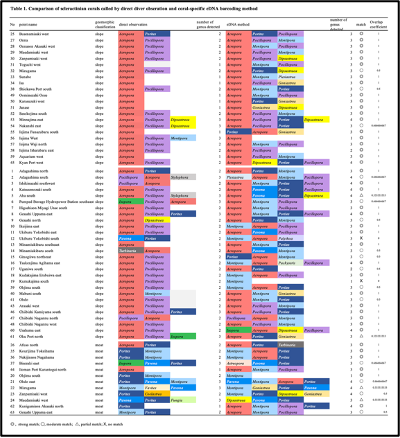
To address this question, we accompanied OESC's visual coral surveys from the summer of 2021 through the spring of 2022 and collected surface seawater samples, presumed to contain coral eDNA, from 62 sites. We then compared the results of the visual surveys (which recorded the two or three dominant coral genera at each site) with the results obtained using the eDNA-M method (which identified three to four dominant genera from the same sites). Importantly, the datasets generated by the two approaches were analyzed independently, without either team having access to the other's results until the final comparison was conducted.
As shown in the table, approximately 90% of the results obtained using the eDNA-M method were consistent with those obtained through direct visual observation. This demonstrated that coral eDNA metabarcoding can provide highly reliable data under real field conditions. Although there remains room for improvement, including investigating the causes of discrepancies at the few sites where the results did not match, these findings gave us strong confidence in the effectiveness of the coral eDNA-M approach.
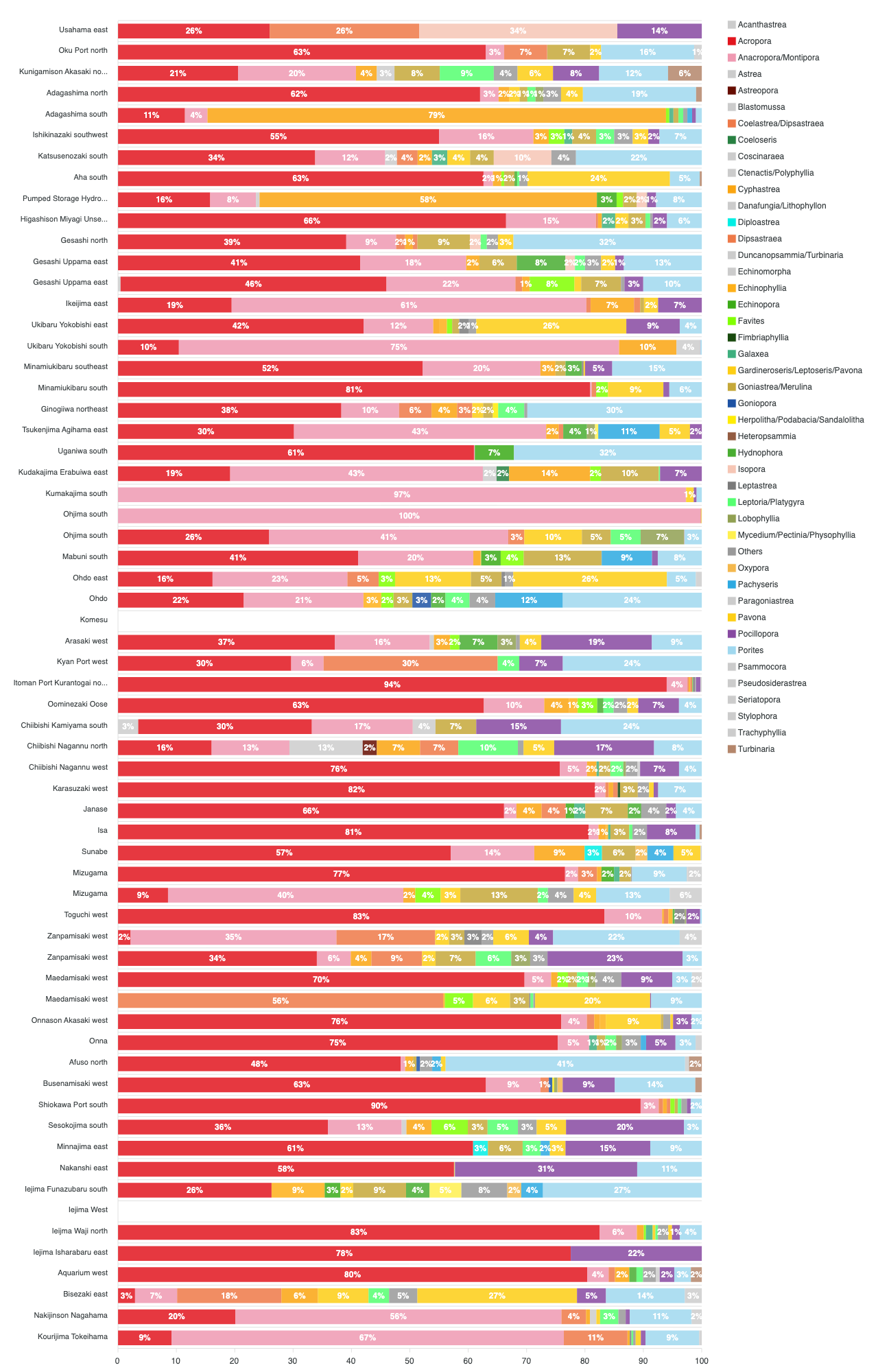
Having established the validity of the method, we examined the dominant coral genera inhabiting the reefs of Okinawa Island and its surrounding islands, including Ie Island, Sesoko Island, Miyagi Island, and Kudaka Island. As shown in the bar graph “Top 10 Dominant Genera Based on eDNA Analysis,” the genus Acropora overwhelmingly dominates throughout this region. In particular, reefs along the coast of Onna Village, around Ie Island, and in the Janase North area are composed of approximately 70–80% Acropora. In short, among the islands of the Ryukyu Archipelago, this region represents one of the strongest centers of Acropora abundance and diversity.
The second most dominant genus is Montipora. Some sites, such as the southern reef flat of Oujima, are almost entirely dominated by Montipora. Although less abundant than Acropora and Montipora, other genera such as Porites and Goniastrea are also common. Overall, Okinawa Island and its surrounding islands support rich coral reef ecosystems characterized by a high diversity of coral genera.
 ミドリイシ属
(
Acropora
)
ミドリイシ属
(
Acropora
)
 トゲミドリイシ属
(
Anacropora
)
/
コモンサンゴ属
(
Montipora
)
トゲミドリイシ属
(
Anacropora
)
/
コモンサンゴ属
(
Montipora
)
 パリカメノコキクメイシ属
(
Coelastrea
)
/
キクメイシ属
(
Dipsastraea
)
パリカメノコキクメイシ属
(
Coelastrea
)
/
キクメイシ属
(
Dipsastraea
)
 トゲキクメイシ属
(
Cyphastrea
)
トゲキクメイシ属
(
Cyphastrea
)
 ニオウミドリイシ属
(
Isopora
)
ニオウミドリイシ属
(
Isopora
)
 シコロサンゴ属
(
Pavona
)
シコロサンゴ属
(
Pavona
)
 ハナヤサイサンゴ属
(
Pocillopora
)
ハナヤサイサンゴ属
(
Pocillopora
)
 ハマサンゴ属
(
Porites
)
ハマサンゴ属
(
Porites
)