Home > Mesophotic sea corals > East Coast of Okinawa Island
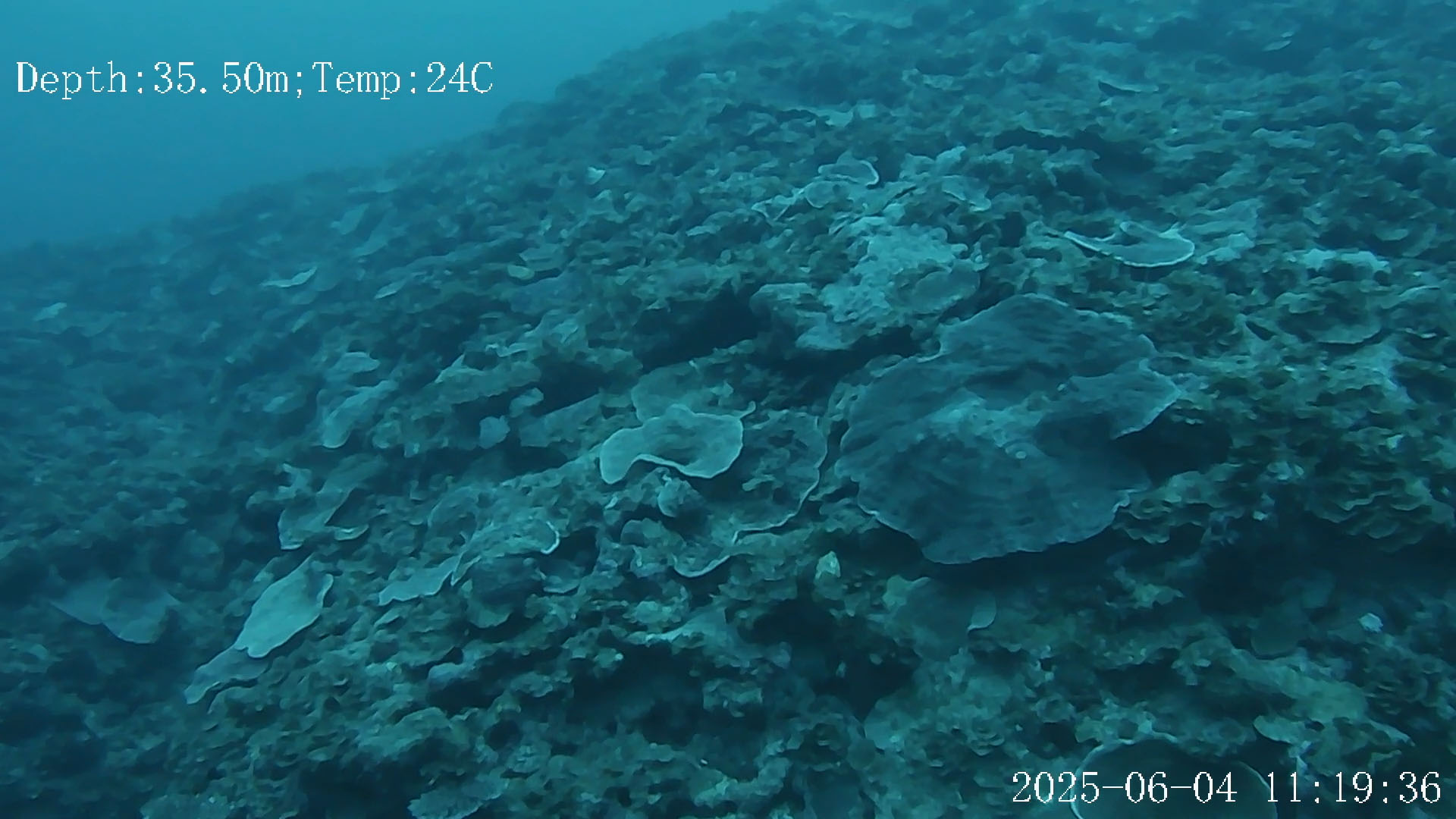
In contrast to the west coast of central Okinawa Island, including the Onna coast, where no large islands occur nearby and the coastline is relatively open and linear, the central and southern parts of the east coast are dotted with sizeable offshore islands. From south to north, these include Kudaka, Tsuken, Hamahiga, Henza, Miyagi, and Ikei Islands. Between these islands, particularly off Henza Island, broad and relatively gentle rocky reef habitats extend across the seafloor. Unlike the west coast, where coral reefs generally continue from shallow waters to depths of around 40 m before transitioning to rubble fields and sandy bottoms at approximately 50 m depth, we hypothesized that mesophotic coral reefs might exist in this area. To investigate this possibility, surveys were conducted from June 4 to 6, 2025.
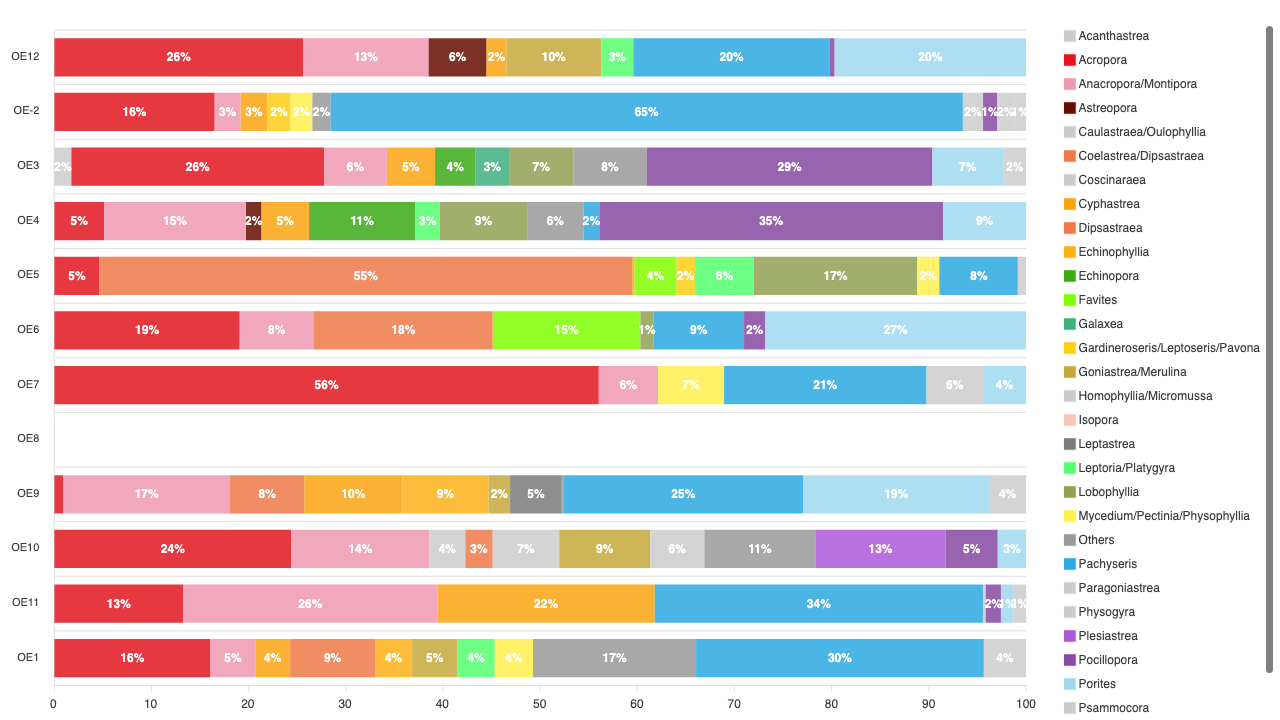
| Point Number | Point Name | Latitude/Longitude | Sampling Depth | Dominant Genus | Percentage |
|---|---|---|---|---|---|
| OE1 |
OE1

|
26.29228396, 128.00803 | 35 m | Pachyseris (リュウモンサンゴ属) | 29.62 % |
| OE-2 |
OE-2
|
26.288552, 128.006794 | 47 m | Pachyseris (リュウモンサンゴ属) | 65.07 % |
| OE3 | OE3 | 26.174752, 127.933076 | 15 m | Pocillopora (ハナヤサイサンゴ属) | 29.39 % |
| OE4 | OE4 | 26.17468704, 127.932764 | 14 m | Pocillopora (ハナヤサイサンゴ属) | 35.39 % |
| OE5 |
OE5
|
26.17018403, 127.944838 | 50 m | Coelastrea (パリカメノコキクメイシ属) / Dipsastraea (キクメイシ属) | 54.83 % |
| OE6 |
OE6
|
26.17419301, 127.940755 | 32 m | Porites (ハマサンゴ属) | 26.86 % |
| OE7 |
OE7
|
26.28122496, 128.014628 | 54 m | Acropora (ミドリイシ属) | 56.03 % |
| OE8 |
OE8
|
26.27476604, 128.015652 | 83 m | not examined | |
| OE9 |
OE9
|
26.38727004, 127.934597 | 27 m | Pachyseris (リュウモンサンゴ属) | 24.7 % |
| OE10 |
OE10
|
26.40420903, 127.94668 | 15 m | Acropora (ミドリイシ属) | 24.38 % |
| OE11 |
OE11
|
26.28553896, 128.007968 | 44 m | Pachyseris (リュウモンサンゴ属) | 33.77 % |
| OE12 |
OE12
|
26.28817096, 128.003962 | 37 m | Acropora (ミドリイシ属) | 25.61 % |
One of the main objectives of our survey off Henza Island was to determine whether the seafloor environment changes with depth in the same way as on Okinawa’s west coast, where coral reefs generally give way to rubble fields and sandy bottoms at around 50 m depth. Although the site numbers are somewhat non-sequential, we deployed the underwater drone progressively from shallow to deeper waters. On the west coast, coral reefs typically transition to rubble fields and then sandy bottoms at depths of 40–50 m. In contrast, off the east coast, algal cover increased with depth. At a depth of 80 m, rocky substrates were largely covered by algae, but a small number of scleractinian corals could still be recognized in the drone footage, most likely Montipora. Depending on the location, the habitat eventually changed to an extensive sandy bottom, as observed at OE10 (100 m), located seaward of OE8.
At this site, underwater drone observations, water sampling, and eDNA analyses were conducted at four locations. These results revealed that shallow sites (OE3 and OE4) support abundant coral communities composed of Pocillopora, Acropora, Montipora, Porites, Lobophyllia, Cyphastrea, and Echinopora, among many others. This area is one of the most beautiful coral reefs along Okinawa’s east coast, with exceptionally high coral cover. Because it is largely outside the range of recreational diving activities, it appears to be one of the few locations where corals have grown with minimal direct human disturbance.
Scleractinian coral eDNA was also detected at relatively deep sites (32 m and 50 m), although the relative abundance was lower at 50 m. Of particular interest was the apparent change in coral community composition with depth. eDNA suggested the presence of Coelastrea, a genus that was scarcely detected in the shallower sites, indicating a shift in dominant coral taxa between shallow and deeper reef habitats.
Because Kin Bay contains shipping routes used by tankers servicing petroleum facilities, we did not expect extensive coral reef development in its deeper waters. Nevertheless, underwater drones were deployed at two sites, 50 m and 55 m deep. Both locations consisted of muddy rather than sandy substrates, and no corals were observed.
In contrast, at two shallower sites within the bay (15 m and 27 m), eDNA analyses detected corals including Montipora, Acropora, and Pachyseris, despite partial cover of the seabed with sand.
 ミドリイシ属
(
Acropora
)
ミドリイシ属
(
Acropora
)
 パリカメノコキクメイシ属
(
Coelastrea
)
/
キクメイシ属
(
Dipsastraea
)
パリカメノコキクメイシ属
(
Coelastrea
)
/
キクメイシ属
(
Dipsastraea
)
 リュウモンサンゴ属
(
Pachyseris
)
リュウモンサンゴ属
(
Pachyseris
)
 ハナヤサイサンゴ属
(
Pocillopora
)
ハナヤサイサンゴ属
(
Pocillopora
)
 ハマサンゴ属
(
Porites
)
ハマサンゴ属
(
Porites
)