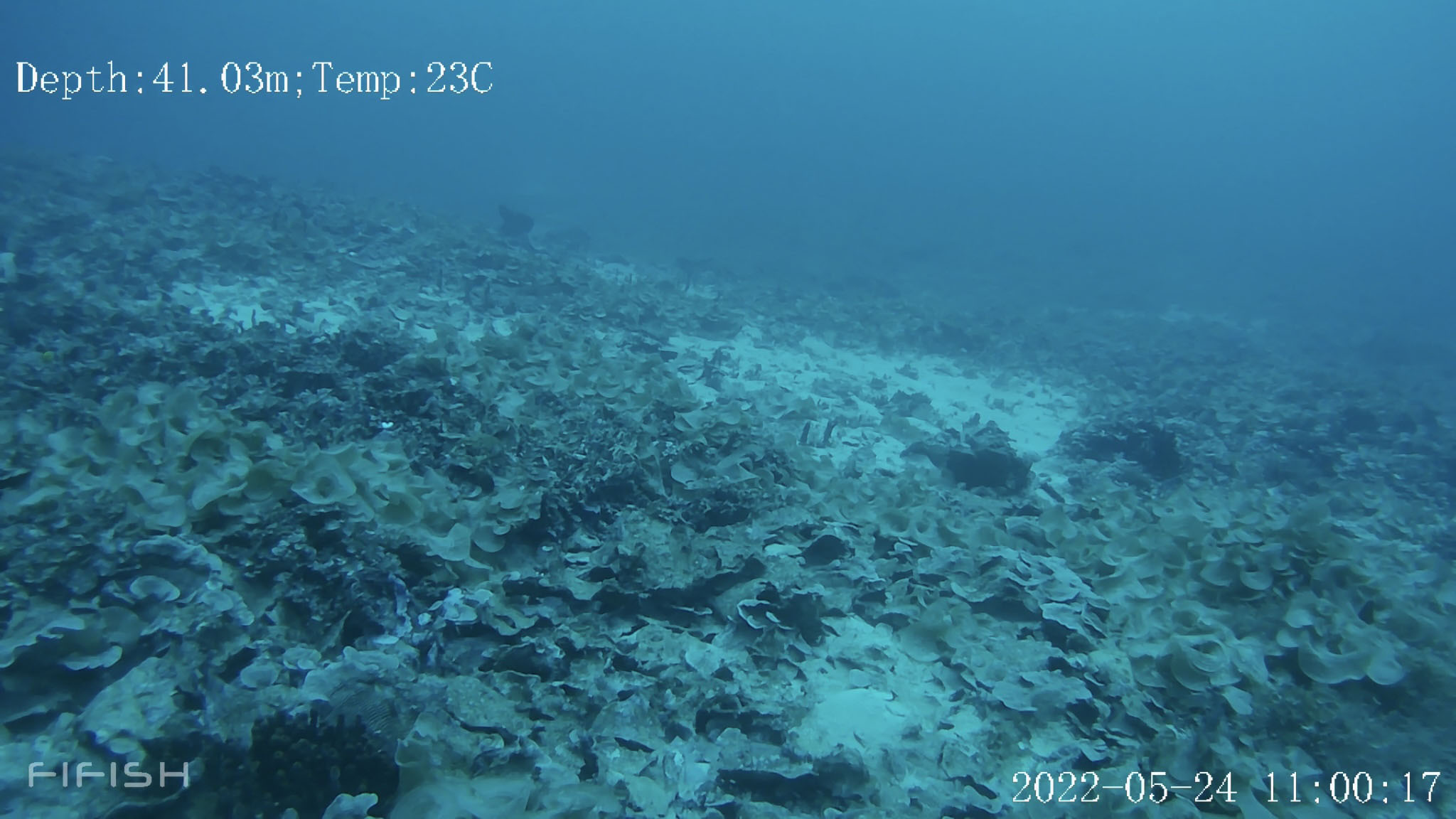
Home > Mesophotic sea corals > Kerama mesophotic
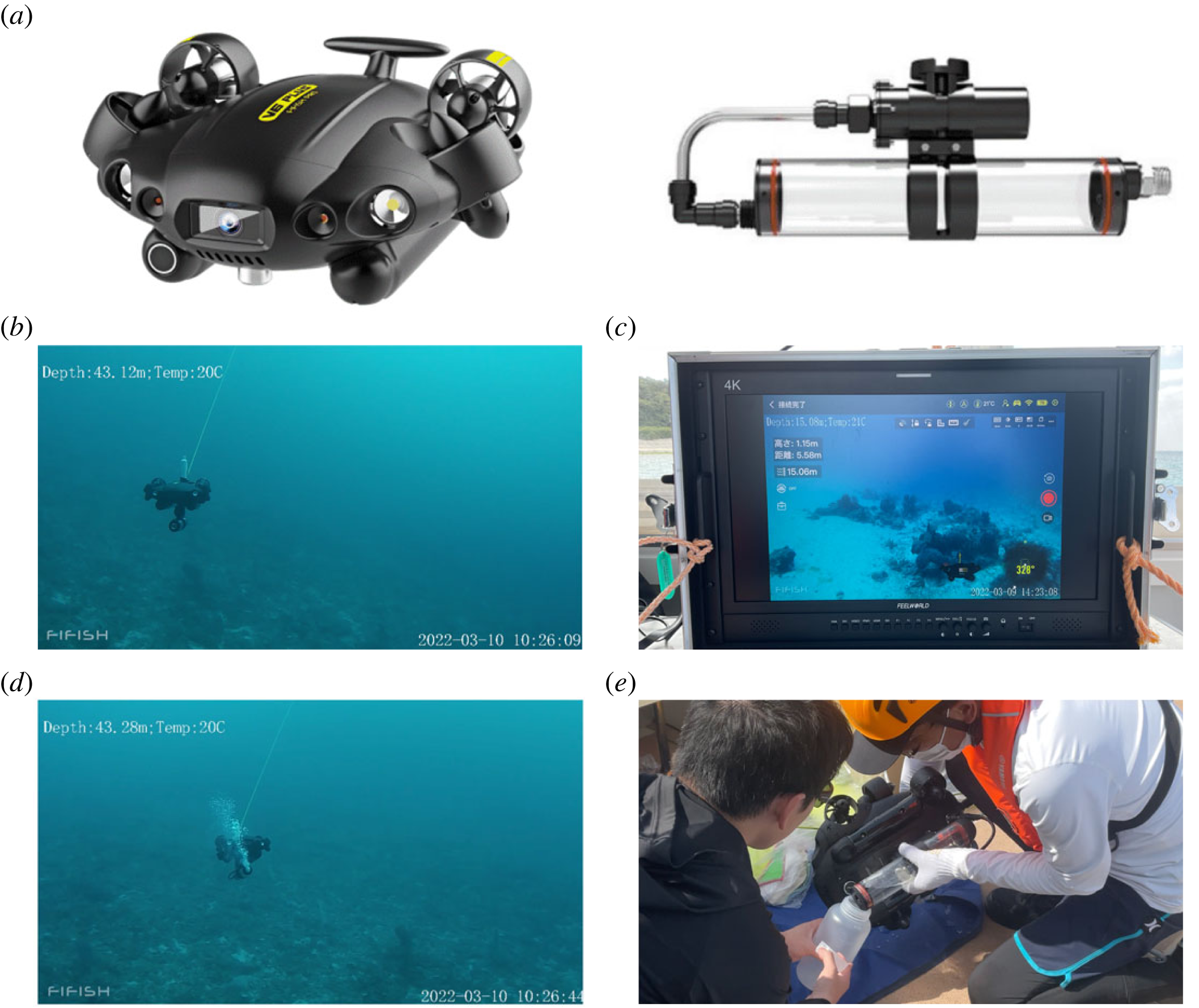
The waters of the Kerama Islands are renowned for their exceptional clarity and are often referred to as “Kerama Blue.” Although ocean currents vary among locations within the archipelago, they are generally strong enough to provide an ideal opportunity to test whether an underwater drone equipped with a water sampler can be controlled from a vessel and used to collect seawater from mesophotic coral reefs. To evaluate this possibility, we first conducted trials using two FIFISH V6 Plus mini underwater robots—one equipped with the water sampler for sample collection and the other used to observe the movements of the sampling vehicle (Figure 1). The sampler operates using a syringe-based mechanism, and successful collection is indicated by the release of air bubbles from inside the sampler (KE-Video1–4). These experiments demonstrated that the system was capable of collecting seawater from mesophotic coral reef environments. The current system has since been upgraded to the FIFISH W6 Plus platform, together with improvements to both the sampling device and battery performance. For details regarding the development and refinement of these research technologies, please refer to Okada et al. (2024), listed in the related publications below.
We then collected seawater samples from 24 sites (six regions) in the Kerama Islands, ranging from the surface to depths of 80 m, in order to investigate whether coral environmental DNA could be detected and whether coral community composition changes with depth.
| Point Number | Point Name | Latitude/Longitude | Sampling Depth | Dominant Genus | Percentage |
|---|---|---|---|---|---|
| A0 | A. Kuba West SF | 26.17423, 127.22865 | 0 m | Acropora (ミドリイシ属) | 69.69 % |
| A40 |
A. Kuba West 40m

|
26.17423, 127.22865 | 40 m | Acropora (ミドリイシ属) | 54.23 % |
| A50 |
A. Kuba West 50m
|
26.17423, 127.22865 | 50 m | not examined | |
| B0 | B. Kuba Northwest SF | 26.18219, 127.233 | 0 m | Acropora (ミドリイシ属) | 85.34 % |
| B9 |
B. Kuba Northwest 9m
|
26.18219, 127.233 | 9 m | Acropora (ミドリイシ属) | 46.16 % |
| B20 |
B. Kuba Northwest 20m
|
26.18219, 127.233 | 20 m | Hydnophora (イボサンゴ属) | 25.26 % |
| B28 |
B. Kuba Northwest 28m
|
26.18219, 127.233 | 28 m | Fungia (シタザラクサビライシ属) | 52.09 % |
| B40 |
B. Kuba Northwest 40m
|
26.18219, 127.233 | 40 m | Dipsastraea (キクメイシ属) | 71.09 % |
| B50 |
B. Kuba Northwest 50m
|
26.18219, 127.233 | 50 m | Anacropora (トゲミドリイシ属) / Montipora (コモンサンゴ属) | 99.89 % |
| C0 | C. Kitahama Beach SF | 26.20615, 127.28625 | 0 m | Acropora (ミドリイシ属) | 89.58 % |
| C15 | C. Kitahama Beach 15m | 26.20615, 127.28625 | 15 m | Acropora (ミドリイシ属) | 52.68 % |
| C28 |
C. Kitahama Beach 28m
|
26.20838, 127.28927 | 28 m | Leptoria (ナガレサンゴ属) / Platygyra (ノウサンゴ属) | 50.07 % |
| C42 |
C. Kitahama Beach 42m
|
26.20804, 127.29432 | 42 m | Acropora (ミドリイシ属) | 74.23 % |
| D0 | D. Kerama West SF | 26.23519, 127.33255 | 0 m | Acropora (ミドリイシ属) | 82.36 % |
| D20 |
D. Kerama West 20m
|
26.23537, 127.33365 | 20 m | Acropora (ミドリイシ属) | 53.27 % |
| D40 |
D. Kerama West 40m
|
26.2355, 127.34677 | 40 m | not examined | |
| E0 | E. Shiru East SF | 26.21689, 127.31063 | 0 m | Acropora (ミドリイシ属) | 72.51 % |
| E20 |
E. Shiru East 20m
|
26.21694, 127.31143 | 20 m | Porites (ハマサンゴ属) | 78.61 % |
| E41 |
E. Shiru East 41m
|
26.21708, 127.31375 | 41 m | Pachyseris (リュウモンサンゴ属) | 67.18 % |
| E50 |
E. Shiru East 50m
|
26.21113, 127.32035 | 50 m | Porites (ハマサンゴ属) | 44.32 % |
| F0 | F. Jijigatama SF | 26.2231, 127.25013 | 0 m | Acropora (ミドリイシ属) | 37.92 % |
| F20 |
F. Jijigatama 20m
|
26.2231, 127.25013 | 20 m | Porites (ハマサンゴ属) | 58.66 % |
| F41 |
F. Jijigatama 41m
|
26.22145, 127.25472 | 41 m | Acropora (ミドリイシ属) | 76.61 % |
| F80 |
F. Jijigatama 80m
|
26.23482, 127.24683 | 80 m | Porites (ハマサンゴ属) | 100 % |
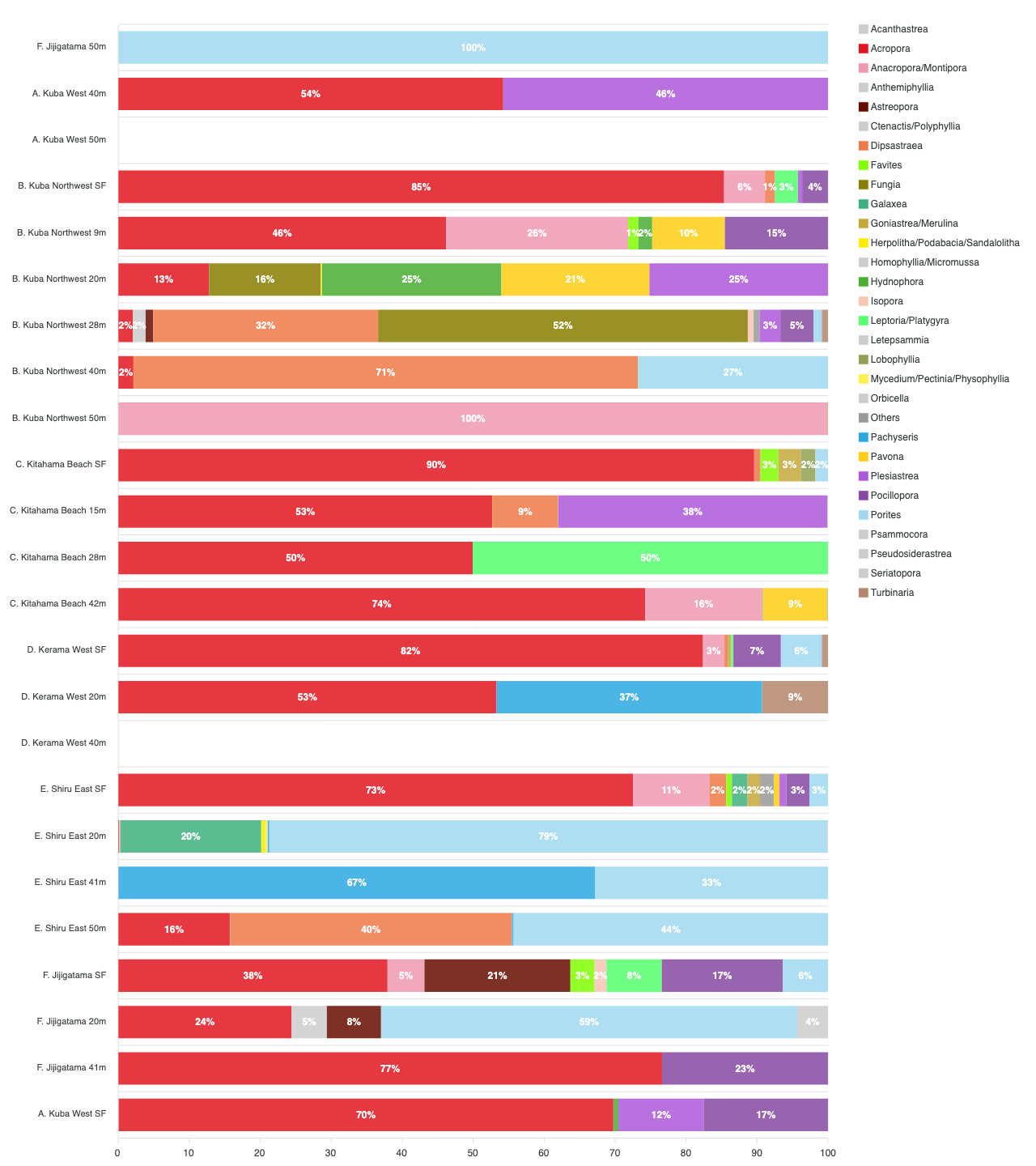
As described above, the combination of an underwater drone equipped with a water sampler and environmental DNA (eDNA) analysis provided a promising approach for exploring mesophotic coral reefs. We therefore collected seawater samples from 24 sites across six regions of the Kerama Islands, ranging from the surface to depths of 80 m, to investigate whether coral eDNA could be detected and whether coral community composition changes with depth. Coral eDNA ZOTU values were successfully obtained from 23 of the 24 sites (sampling itself could not be conducted at Kuba West 50 m because of rough sea conditions). At the single site where coral DNA was not detected (Kerama West 40 m), examination of the drone footage recorded during sampling revealed that the seafloor was covered only by algae and lacked corals. These results gave us confidence that this method can be effectively applied to eDNA analyses of mesophotic coral reefs.
Although the system was limited to collecting only a single water sample during each survey, we nevertheless obtained evidence suggesting that coral community composition may change with depth at certain locations. One such example was the Kuba Northwest site. In shallow water, staghorn corals (Acropora) were the dominant genus. However, as depth increased, the proportion of Acropora decreased, while the mushroom coral genus Fungia and the brain coral genus Dipsastraea became dominant. The Kuba Northwest site faces the open ocean and experiences strong currents, and even this single example suggests that the dominance of coral genera may vary with depth. We hope to conduct follow-up surveys in the future to further investigate this pattern.
In general, the beautiful coral reefs of the Kerama Islands are distributed across relatively shallow rocky substrates. Beyond depths of approximately 35 m, these reefs gradually transition into sandy bottoms, and the common impression is that coral colonies become increasingly scarce and eventually disappear as depth increases further. We therefore sought to determine how deep corals occur in these exceptionally clear waters, including not only stony corals (Hexacorallia) but also so-called soft corals (Octocorallia), with a target depth of 100 m. In practice, simply locating areas within the Kerama Islands where depths of 100 m could be reached proved challenging.
After several exploratory surveys, we succeeded in discovering a soft-coral community dominated by sea fans and gorgonians at a depth of approximately 100 m off the southeastern coast of Kuba Island. Water currents at the site were extremely strong, making it difficult to keep the drone camera stationary. We believe that this discovery would not have been possible without the exceptional skills of drone operator Yuki Shimizu. In recognition of her contribution, we named the site “Yuki Reef.” This represents one of the few documented cases in the Ryukyu Islands where corals, including soft corals, have been investigated at depths approaching 100 m.
 ミドリイシ属
(
Acropora
)
ミドリイシ属
(
Acropora
)
 トゲミドリイシ属
(
Anacropora
)
/
コモンサンゴ属
(
Montipora
)
トゲミドリイシ属
(
Anacropora
)
/
コモンサンゴ属
(
Montipora
)
 キクメイシ属
(
Dipsastraea
)
キクメイシ属
(
Dipsastraea
)
 シタザラクサビライシ属
(
Fungia
)
シタザラクサビライシ属
(
Fungia
)
 イボサンゴ属
(
Hydnophora
)
イボサンゴ属
(
Hydnophora
)
 ナガレサンゴ属
(
Leptoria
)
/
ノウサンゴ属
(
Platygyra
)
ナガレサンゴ属
(
Leptoria
)
/
ノウサンゴ属
(
Platygyra
)
 リュウモンサンゴ属
(
Pachyseris
)
リュウモンサンゴ属
(
Pachyseris
)
 ハマサンゴ属
(
Porites
)
ハマサンゴ属
(
Porites
)