Home > Mesophotic sea corals > Onna mesophotic
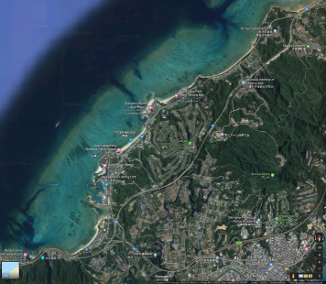
An aerial view of the coast of Onna Village (Fig. 1A) shows that an “Ino” (reef flat: a shallow area enclosed by coral reefs in the Okinawan language) extends for approximately 32 km from the northeastern side of Cape Zanpa to Busena Marine Park (light blue area). The central part of the Ino near Maeganeku consists largely of sandy bottom, where mozuku seaweed aquaculture is practiced, representing one of the many benefits provided by reef ecosystems. Although the scenery varies from place to place, many areas feature a rocky reef zone at the outer edge of the Ino (visible as the light-brown area), where coral reefs typically begin. Beyond this zone, the seafloor gradually deepens, with the dark-blue area corresponding to depths of approximately 10–200 m. Farther offshore, the seabed drops steeply into the deep ocean, shown in light blue. Within the reef lagoons and rocky reef areas, one can observe large colonies of branching corals, table corals, and many other genera, including Acropora and Montipora. Furthermore, the “Blue Cave” at Cape Maeda and the coral reefs beneath Cape Manzamo are among Okinawa’s most famous diving destinations.
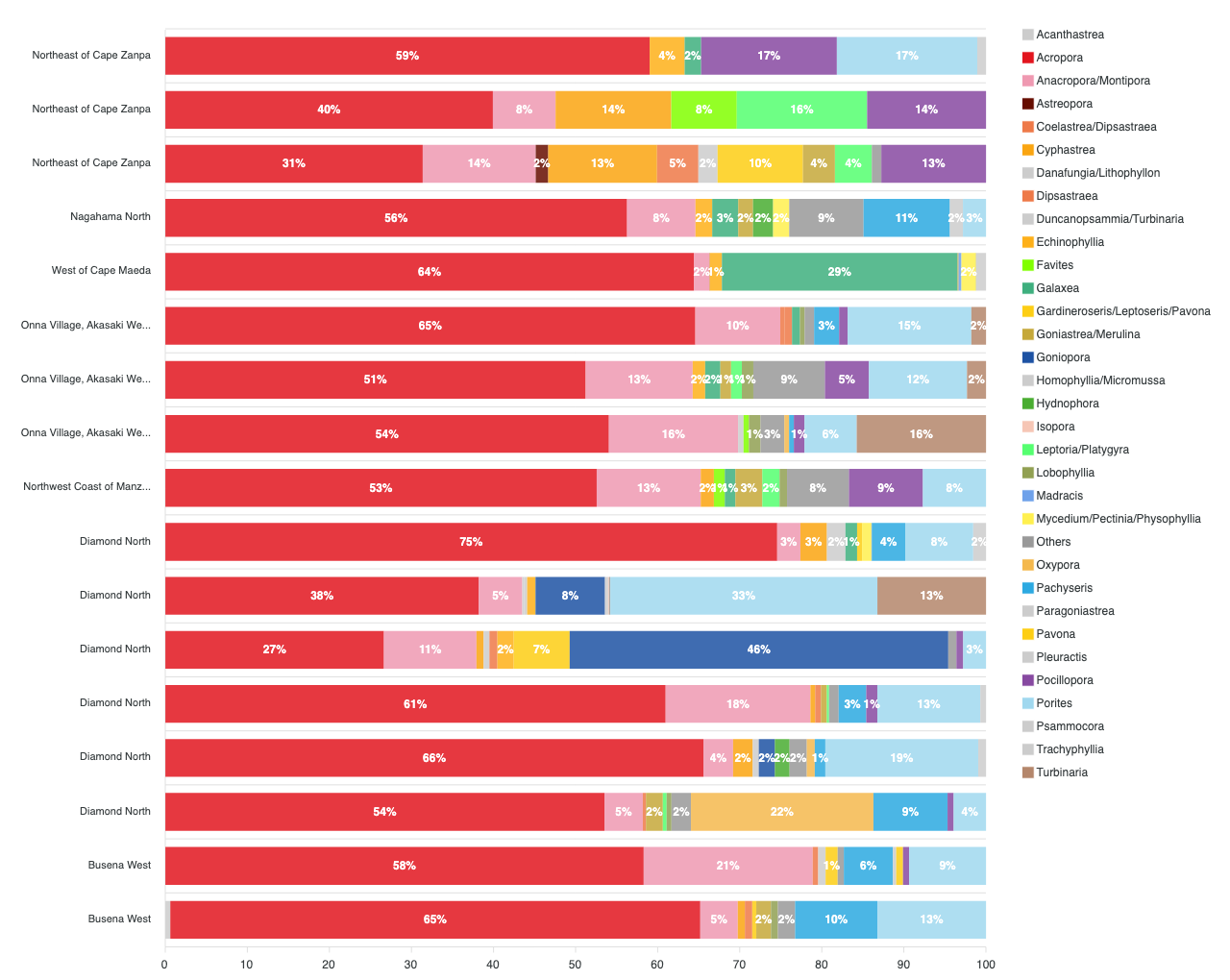
How deep do the shallow coral reefs along the coast of Onna Village extend? To investigate this question, we conducted a series of mesophotic coral eDNA surveys, from below Cape Zanpa to Maeganeku in autumn 2022, from Maeganeku to the vicinity of Cape Manzamo in spring 2023, and from Seragaki to Busena in autumn 2023.
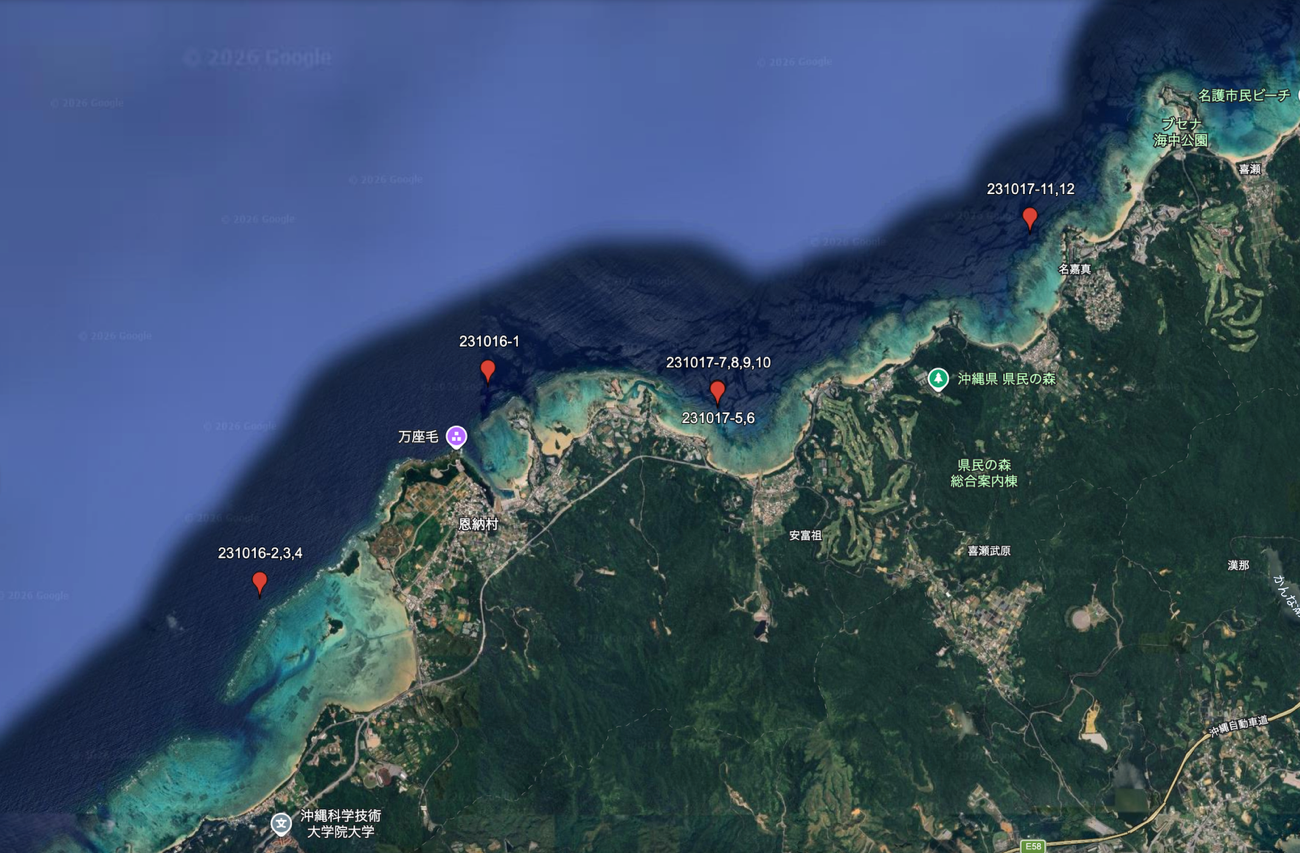
Although the overall eDNA analysis is still ongoing, we briefly introduce results from northwestern Cape Manzamo site using footage obtained with the underwater drone.
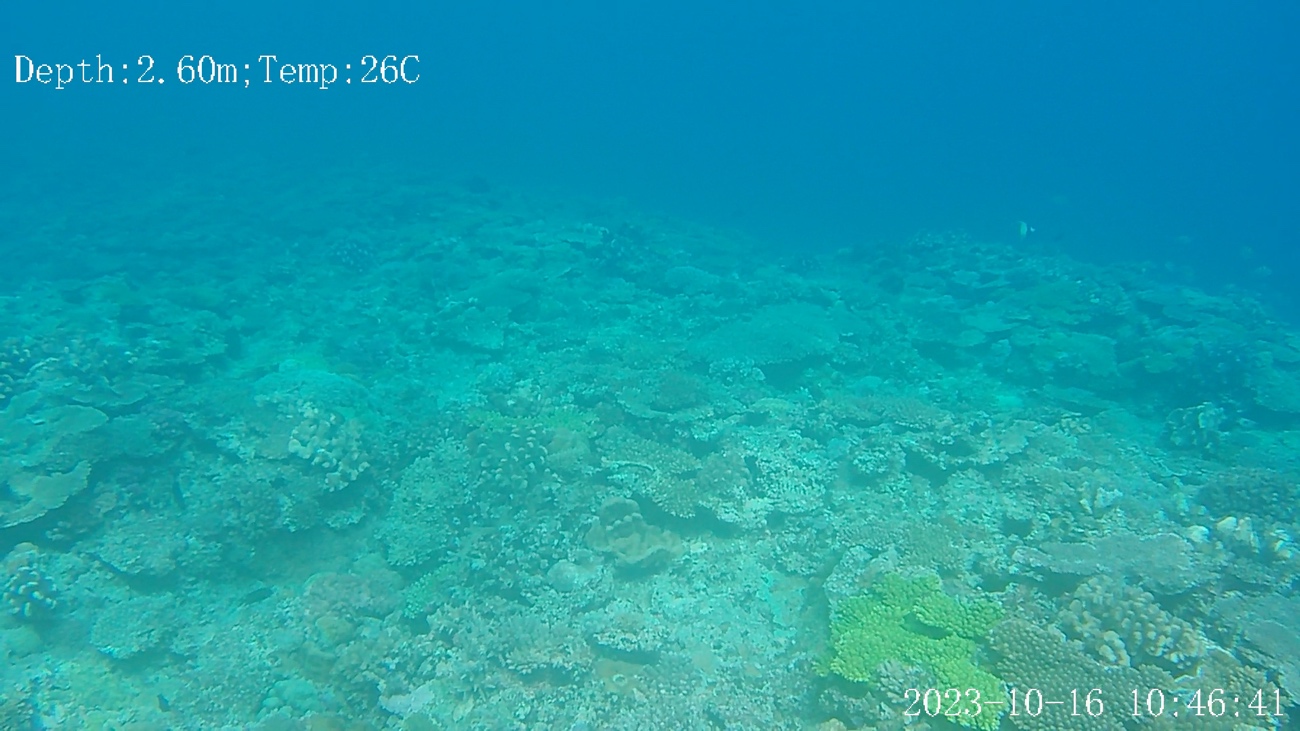
Northwest of Cape Manzamo, depth 2.6 m. Numerous corals, including Acropora and Porites, form dense communities on the shallow reef.
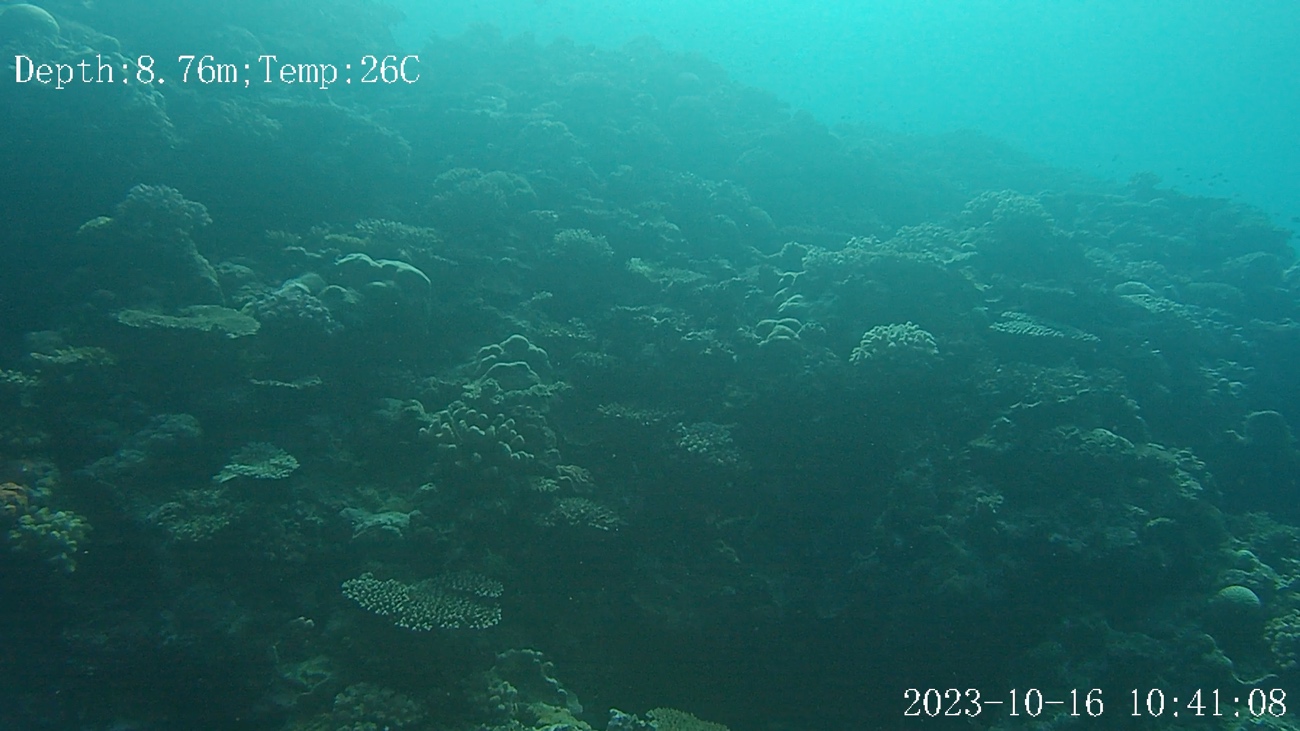
Northwest of Cape Manzamo, depth 8.8 m. The shallow reef transitions into a rocky area, where many corals, including Acropora, continue to thrive.
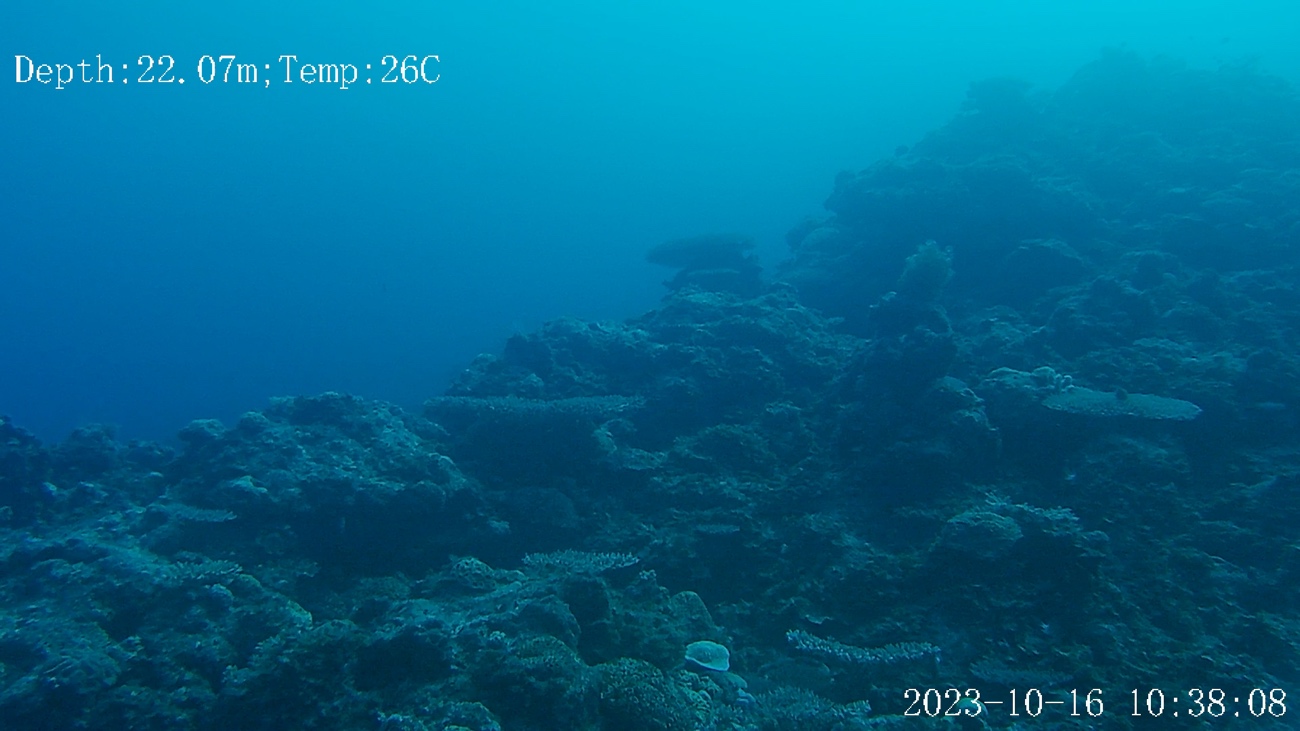
Northwest of Cape Manzamo, depth 21.8 m. A gently sloping reef face where dense coral communities continue.
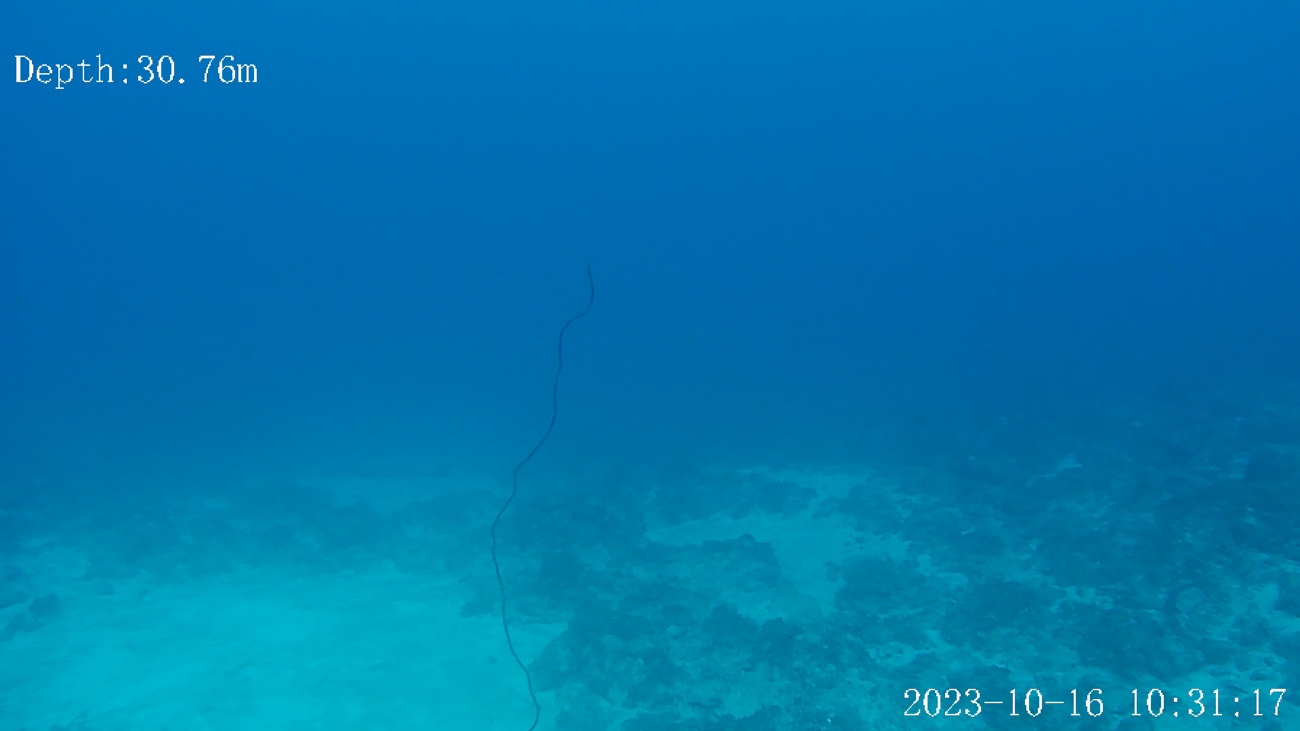
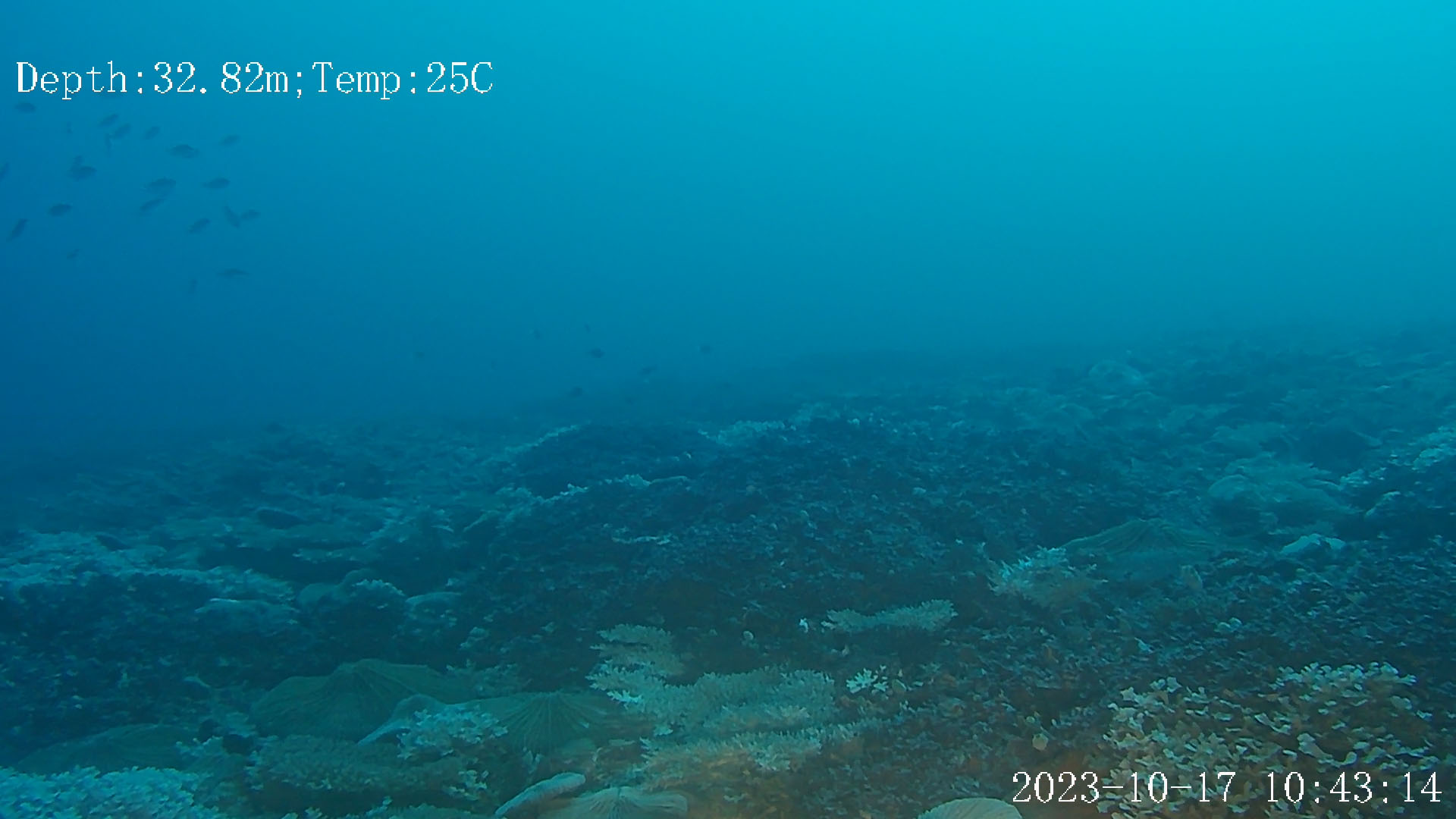
Northwest of Cape Manzamo, depth 30.8 m. Coral communities become less abundant and gradually transition into coral rubble habitat.
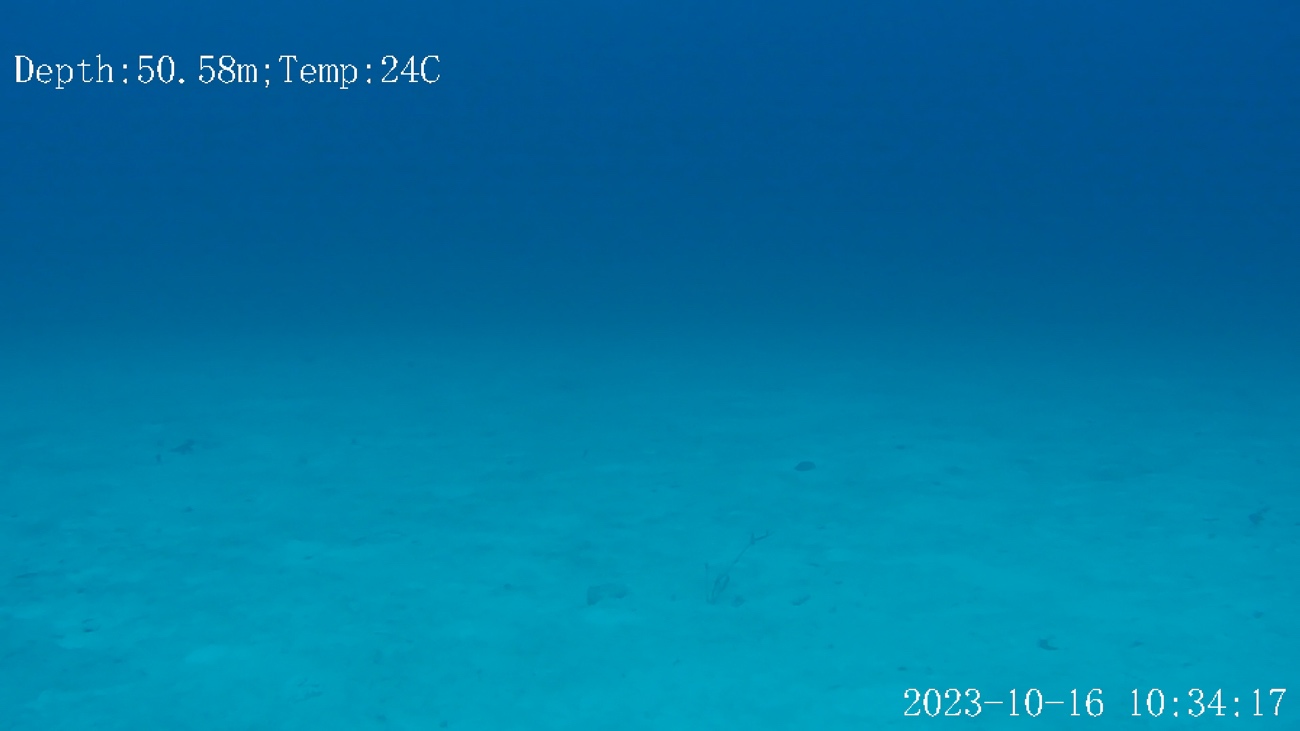
Northwest of Cape Manzamo, depth 50.6 m. Sandy mesophotic habitat with no visible corals.
| Point Number | Point Name | Latitude/Longitude | Sampling Depth | Dominant Genus | Percentage |
|---|---|---|---|---|---|
| 1-2m | Northeast of Cape Zanpa | 26.44036101, 127.719075 | 2 m | Acropora (ミドリイシ属) | 31.36 % |
| 1-65m | Northeast of Cape Zanpa | 26.44443302, 127.720532 | 65 m | Acropora (ミドリイシ属) | 39.91 % |
| 1-43m | Northeast of Cape Zanpa | 26.44353901, 127.719889 | 43 m | Acropora (ミドリイシ属) | 59.02 % |
| 2-33m | Nagahama North | 26.43954, 127.738811 | 33 m | Acropora (ミドリイシ属) | 56.27 % |
| 3-33m | West of Cape Maeda | 26.44307298, 127.753021 | 23 m | Acropora (ミドリイシ属) | 64.42 % |
| 4-32m |
Onna Village, Akasaki West Reef Slope

|
26.489883, 127.827583 | 32 m | Acropora (ミドリイシ属) | 64.57 % |
| 4-S | Onna Village, Akasaki West Reef Slope | 26.489883, 127.827583 | 0 m | Acropora (ミドリイシ属) | 51.22 % |
| 4-47m |
Onna Village, Akasaki West Reef Slope
|
26.489883, 127.827583 | 47 m | Acropora (ミドリイシ属) | 54.05 % |
| 5-S | Northwest Coast of Manzamo | 26.512, 127.8542 | 0 m | Acropora (ミドリイシ属) | 52.56 % |
| 6-S1 | Diamond North | 26.5099, 127.880983 | 0 m | Acropora (ミドリイシ属) | 60.97 % |
| 6-21.7m |
Diamond North
|
26.5099, 127.880983 | 21.7 m | Goniopora (ハナガササンゴ属) | 46.14 % |
| 6-S2 | Diamond North | 26.509783, 127.880983 | 0 m | Acropora (ミドリイシ属) | 53.51 % |
| 6-32.4m |
Diamond North
|
26.509783, 127.880983 | 32.4 m | Acropora (ミドリイシ属) | 38.18 % |
| 6-35m |
Diamond North
|
26.509783, 127.880983 | 35 m | Acropora (ミドリイシ属) | 65.57 % |
| 6-39m |
Diamond North
|
26.509783, 127.880983 | 39 m | Acropora (ミドリイシ属) | 74.56 % |
| 7-21m |
Busena West
|
26.527883, 127.917433 | 21 m | Acropora (ミドリイシ属) | 64.57 % |
| 7-24.4m |
Busena West
|
26.527883, 127.917433 | 24.4 m | Acropora (ミドリイシ属) | 58.29 % |
The waters off northwestern Cape Manzamo represent one of the characteristic coral reef landscapes along the west coast of Okinawa Island. Nearshore, a shallow lagoon enclosed by the reef crest (known locally as inō) extends along the coast, while beyond it the seabed gradually descends from rocky reef flats to reef slopes. The clear waters support a diverse coral community, including Acropora, Porites, and members of the family Merulinidae, making this area a popular destination for both divers and snorkelers. In this survey, we examined a continuous depth gradient off northwestern Cape Manzamo, from approximately 2.6 m to 50.6 m depth, to investigate how coral communities change with increasing depth.
At a depth of 2.6 m, a healthy and diverse coral community can be observed, including Acropora, Porites, and various merulinid corals (Fig. 2A). This situation remains largely unchanged at 8.8 m depth, where the gently sloping shallow seabed transitions into a rocky reef habitat (Fig. 2B). Coral cover here appears to exceed 80%. This coral-dominated rocky reef continues beyond 20 m depth (Fig. 2C). However, as depth increases further, coral abundance gradually declines, and by approximately 30 m depth the habitat begins to resemble a rubble field interspersed with sandy patches (Fig. 2D). At depths of 40–50 m, corals largely disappear, and the seabed transitions from rubble to unconsolidated sand (Fig. 2E; depth 50.6 m). We continued observations down to approximately 90 m depth, where sandy substrate remained dominant (the dark blue zone shown in Fig. 1A). We speculate that similar conditions continue until the seabed drops steeply into the adjacent deep sea. At survey point 231016-4, a rubble-dominated habitat begins at approximately 40 m depth.

