Home > Ryukyu Islands > Kerama
The Kerama Islands are located west of Okinawa Island, approximately 30 km from Naha Airport. In addition to relatively large islands such as Tokashiki, Zamami, and Aka Islands, numerous small uninhabited islands are scattered throughout the area, creating a complex geographic setting. Coral reefs of the Kerama Islands suffered severe damage from the mass coral bleaching event of 1998 and the outbreak of crown-of-thorns starfish around 2000. Since then, however, the reefs have gradually recovered, and in 2014 the Kerama Islands were designated as a national park.
To better understand characteristics of coral reefs at Okinawa Island and the Keramas, in 2023 we conducted a coral reef survey using environmental DNA (eDNA). Among the survey sites, Ago-no-Ura represents the most enclosed bay-like environment. In contrast, waters surrounded by Tokashiki, Zamami, and Aka Islands are characterized by strong circulation and differ from typical enclosed bays, while still being sheltered from direct exposure to the open ocean and remaining relatively shallow. The survey sites located northwest of Zamami and Aka Islands, on the other hand, are more strongly influenced by open-ocean conditions.
| Point Number | Point Name | Latitude/Longitude | Dominant Genus | Percentage |
|---|---|---|---|---|
| 1 | Maenohama | 26.18639, 127.28124 | Anacropora (トゲミドリイシ属) / Montipora (コモンサンゴ属) | 56.15 % |
| 2 | Agu_1 | 26.19422, 127.27212 | Anacropora (トゲミドリイシ属) / Montipora (コモンサンゴ属) | 42.76 % |
| 3 | Agu_2 | 26.19489, 127.2741 | Anacropora (トゲミドリイシ属) / Montipora (コモンサンゴ属) | 68.13 % |
| 4 | Hizushi | 26.18815, 127.27184 | Anacropora (トゲミドリイシ属) / Montipora (コモンサンゴ属) | 54.97 % |
| 5 |
Kuba Northwest

|
26.17759, 127.23341 | Acropora (ミドリイシ属) | 25.25 % |
| 6 | Yagabi East | 26.21105, 127.25092 | Acropora (ミドリイシ属) | 35.16 % |
| 7 |
Kushibaru
|
26.20346, 127.26637 | Acropora (ミドリイシ属) | 63.22 % |
| 8 |
Nita
|
26.23769, 127.29158 | Acropora (ミドリイシ属) | 79.22 % |
| 9 | Yuhina | 26.2415, 127.29954 | Acropora (ミドリイシ属) | 59.15 % |
| 10 |
Agonoura
|
26.23748, 127.3201 | Anacropora (トゲミドリイシ属) / Montipora (コモンサンゴ属) | 34.02 % |
| 11 | Ariga | 26.20633, 127.34832 | Acropora (ミドリイシ属) | 73.41 % |
| 12 | Aharen | 26.17284, 127.34032 | Anacropora (トゲミドリイシ属) / Montipora (コモンサンゴ属) | 53.59 % |
| 13 |
Majanohama
|
26.19243, 127.28824 | Anacropora (トゲミドリイシ属) / Montipora (コモンサンゴ属) | 80.5 % |
| 14 | Nishibama | 26.20177, 127.28963 | Anacropora (トゲミドリイシ属) / Montipora (コモンサンゴ属) | 38.29 % |
| 15 | Gahi South | 26.21522, 127.2871 | Acropora (ミドリイシ属) | 57.46 % |
| 16 |
Gahi Front Shallow
|
26.21974, 127.2885 | Acropora (ミドリイシ属) | 59.25 % |
| 17 | Gahi Front Deep | 26.21975, 127.28939 | Acropora (ミドリイシ属) | 40.81 % |
| 18 | Amuro West Shallow | 26.21101, 127.30686 | Pavona (シコロサンゴ属) | 35.22 % |
| 19 |
Amuro South
|
26.20163, 127.31732 | Anacropora (トゲミドリイシ属) / Montipora (コモンサンゴ属) | 33.41 % |
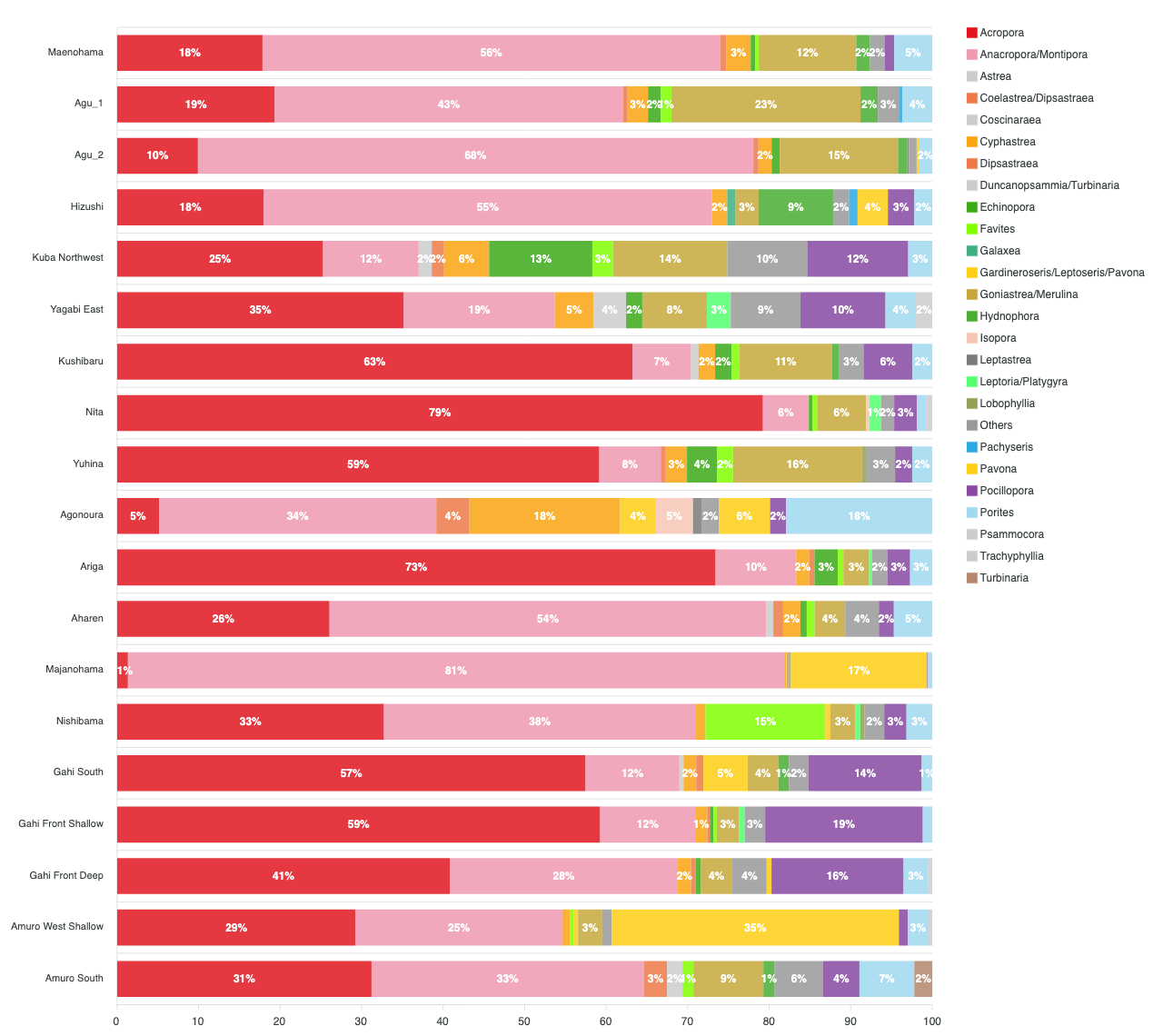
eDNA surveys revealed that coral reefs of the Kerama Islands possess characteristics distinct from those of Okinawa Island. Coral reefs around Okinawa Island are generally dominated by the genus Acropora, a pattern that was confirmed by both eDNA surveys conducted in 2021–2022 and concurrent visual assessments made by divers. In contrast, among the Kerama Islands, high abundances of Acropora DNA were detected mainly at Arigaa, on the northwestern coast of Tokashiki Island, and at survey sites on the northwestern sides of Aka and Zamami Islands. At most other survey sites, the dominant genus was Montipora.
The reason for this difference remains unclear. However, it may be related to the unique geomorphological and oceanographic characteristics of the Kerama Islands. In addition, the number of coral genera detected per survey site was generally higher in the Kerama Islands than around Okinawa Island, indicating that the coral reefs of the Kerama Islands support a more diverse coral community.
One notable geographical characteristic of the Kerama Islands is that summer seawater temperatures tend to be less extreme than those around Okinawa Island. Our eDNA surveys conducted in 2023 detected relatively high abundances of the genus Seriatopora, which is vulnerable to thermal stress, compared with reefs around Okinawa Island. This finding suggests a more favorable thermal environment at the Kerama Islands.


