Home > Ryukyu Islands > the Iheya - Izena Islands
The Iheya - Izena Islands are located north of the Motobu Peninsula of Okinawa Island, comprising five main islands: Iheya, Noho, Gushikawa, Izena, and Yanaha Islands. Iheya Island lies approximately 41 km north of the Motobu Peninsula and is a long, narrow island extending in a north–south direction. It has an area of approximately 20.6 km² and a coastline of 34.2 km. Yoron Island of Kagoshima Prefecture is located about 37 km to the east. Iheya Island is characterized by relatively high mountains, steep coastlines, and well-developed coral reefs. Izena Island, located south of Iheya Island, is comparatively flat, with an area of approximately 14.1 km² and a coastline of about 16.7 km.
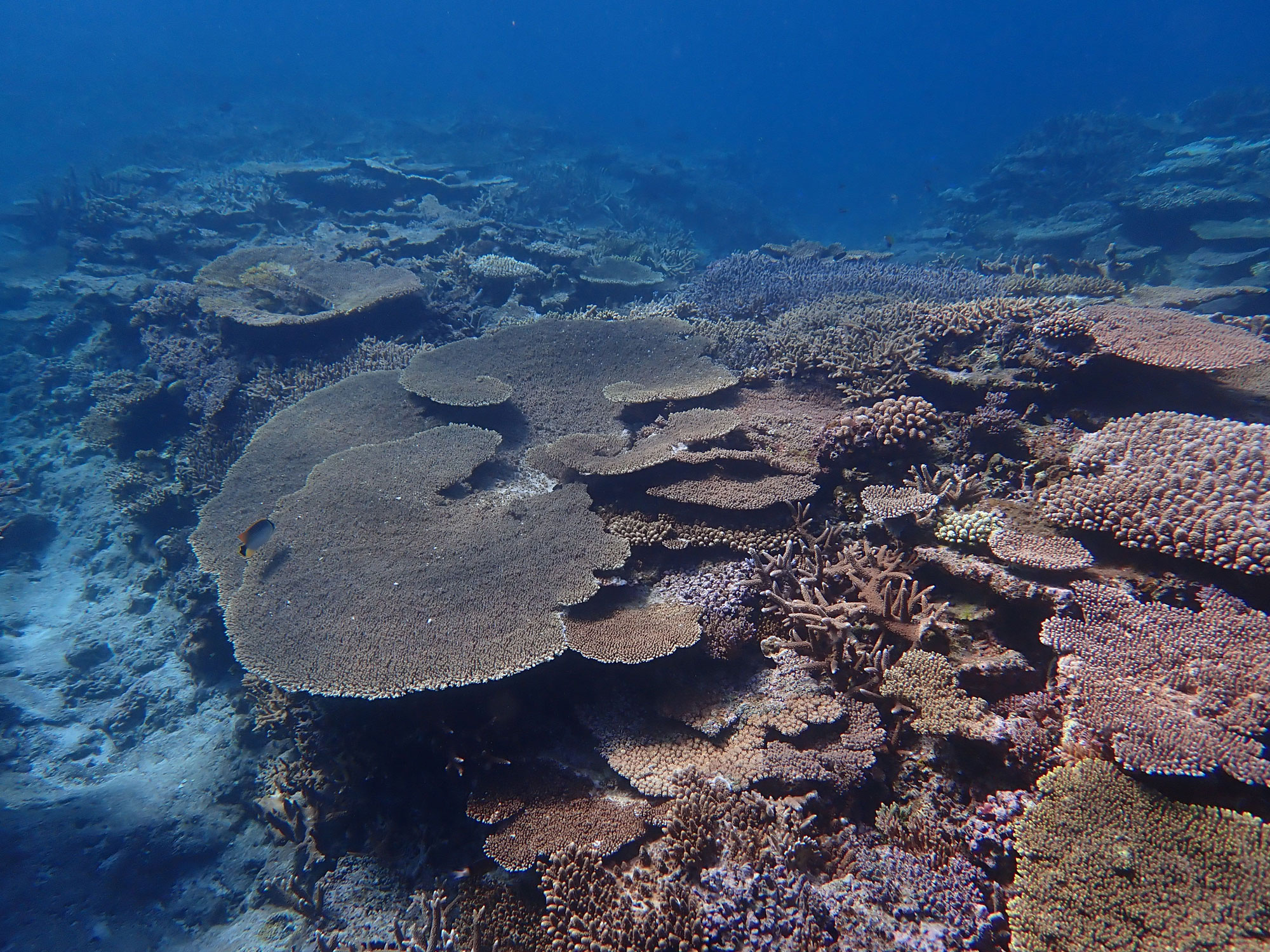
The composition of coral genera inhabiting coral reefs changes through repeated cycles of disturbance and recovery. Disturbances such as typhoons and elevated sea temperatures can severely damage coral reefs, after which they gradually regenerate. In recent decades, impacts of global warming on coral reefs have become increasingly significant. Large-scale coral bleaching events caused by unusually high summer sea temperatures have occurred worldwide on four occasions between 1997 and 2026. Although coral reefs around the world have generally experienced degradation, characterized by declines in coral abundance, some regions have shown exceptional recovery. The region from northern Okinawa Island to the Izena–Iheya Islands is one of the regions where coral reefs had recovered particularly well. To investigate which coral genera inhabit these well-recovered reefs, we conducted both environmental DNA surveys and visual underwater surveys, primarily on Iheya Island on January 13, 2024, and on Izena Island on January 14, 2024. As shown herein, 20 survey sites were examined.
| Point Number | Point Name | Latitude/Longitude | Dominant Genus | Percentage |
|---|---|---|---|---|
| 1 |
Nohojima north

|
27.00252, 127.91913 | Acropora (ミドリイシ属) | 78.74 % |
| 2 |
Hijagama north
|
27.04788, 127.95055 | Acropora (ミドリイシ属) | 88.06 % |
| 3 |
Yaheishi west
|
27.09077, 127.99358 | Acropora (ミドリイシ属) | 98.01 % |
| 4 |
Kubayama south
|
27.08669, 128.02075 | Acropora (ミドリイシ属) | 50.45 % |
| 5 |
Iheyajima east Ufuguchi north
|
27.06433, 128.00538 | Acropora (ミドリイシ属) | 57.5 % |
| 6 |
Maedake south
|
27.03397, 127.98848 | Acropora (ミドリイシ属) | 77.79 % |
| 7 |
Meshi south
|
27.0005, 127.95043 | Acropora (ミドリイシ属) | 75.57 % |
| 8 |
Gushikawajima north
|
26.98398, 127.95445 | Acropora (ミドリイシ属) | 85.81 % |
| 9 |
Nohoohashi south
|
26.98835, 127.92905 | Acropora (ミドリイシ属) | 84.91 % |
| 10 |
Yuugisaki west
|
26.97686, 127.93883 | Acropora (ミドリイシ属) | 67.78 % |
| 11 |
Uchihanabashi north
|
26.95701, 127.92842 | Acropora (ミドリイシ属) | 46.24 % |
| 12 |
Uchihanakou north
|
26.95758, 127.94411 | Acropora (ミドリイシ属) | 58.17 % |
| 13 |
Agarisaki south east
|
26.97173, 127.96145 | Acropora (ミドリイシ属) | 52.43 % |
| 14 |
Gushikawajima north Pocillopora
|
26.98556, 127.95445 | Acropora (ミドリイシ属) | 71.67 % |
| 15 |
Mennayama east
|
26.93969, 127.96437 | Acropora (ミドリイシ属) | 82.76 % |
| 16 |
Agigitara south
|
26.91049, 127.94383 | Acropora (ミドリイシ属) | 77.33 % |
| 17 |
Izenajima south green mark
|
26.90775, 127.93911 | Acropora (ミドリイシ属) | 79.33 % |
| 18 |
Yanahasaki south east
|
26.88801, 127.93808 | Acropora (ミドリイシ属) | 70.5 % |
| 19 |
Hinpunkusashi south
|
26.89985, 127.91536 | Acropora (ミドリイシ属) | 83.51 % |
| 20 |
Izenajima west
|
26.92022, 127.91606 | Acropora (ミドリイシ属) | 56.78 % |
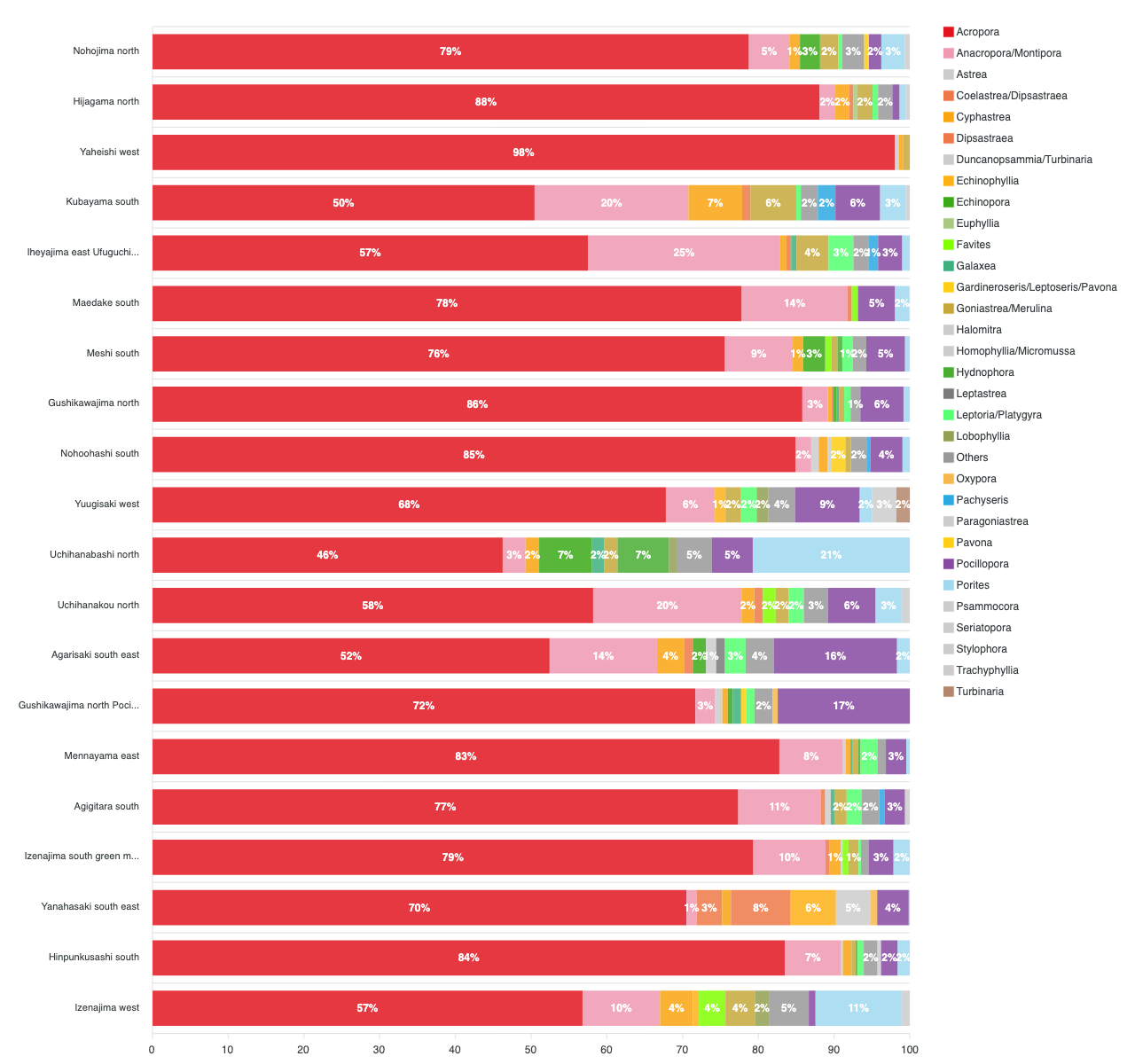
Based on environmental DNA (eDNA) analysis, coral reef communities on southern Iheya Island and neighboring Izena Island are composed of remarkably similar coral genera. In both islands, the genus Acropora was the dominant coral taxon at nearly all survey sites. Particularly high dominance of Acropora was observed at sites IHY1–3 on the southwestern slope between Iheya Island and Noho Island, as well as at sites IHY8 and IHY9 at the southern tip of Iheya Island. A similar pattern was also evident at sites IZN5–7 and IZN9 on Izena Island. The second most abundant genus was Montipora, especially at sites IHY4 and IHY5 at northeastern Iheya Island. Overall, these results indicate that coral reefs characterized by very similar assemblages of coral genera are distributed continuously across both Iheya and Izena Islands.
There are two possible interpretations regarding the formation and maintenance of coral reefs on these islands. One is that their coral communities are strongly influenced by northern Okinawa Island, in which case dominance by Acropora would be expected. The other possibility is that these islands resemble more isolated northern offshore islands such as Aguni Island and Tonaki Island. In such settings, Acropora is not necessarily dominant; instead, several genera, including Montipora, Goniastrea, Cyphastrea, and Porites, tend to occur as co-dominant components of a more balanced coral assemblage. The present results clearly suggest that coral reefs of Iheya and Izena Islands are closely connected to those of Okinawa Island.
Although corals of the genus Acropora are highly susceptible to bleaching, they also grow rapidly and dispersal widely. If the recent recovery of coral reefs in the Iheya–Izena region and northern Okinawa Island is indeed driven largely by expansion of Acropora populations, then the results obtained from both the eDNA analyses and visual surveys are entirely consistent with this interpretation.
