Home > Ryukyu Islands > Miyako Island and Yabiji
Yabiji Reef is an extensive coral reef complex scattered across an area approximately 5 km east–west and 20 km north–south, located north of Miyako Island. It is well known that four global mass coral bleaching events caused by unusually high summer seawater temperatures had occurred by 2025. Compared with coral reefs around Okinawa Island and other relatively high-latitude regions of Japan, the coral reefs of the Miyako Island region suffered particularly severe damage during the 2016 mass bleaching event. By 2023, when we conducted our environmental DNA (eDNA) survey, the reefs had recovered substantially from this disturbance, providing an opportunity to examine the composition of coral communities during the recovery phase.
| Point Number | Point Name | Latitude/Longitude | Dominant Genus | Percentage |
|---|---|---|---|---|
| 1 |
Nanseien

|
24.860347, 125.307878 | Anacropora (トゲミドリイシ属) / Montipora (コモンサンゴ属) | 88.78 % |
| 2 |
Utu north
|
25.056122, 125.277039 | Acropora (ミドリイシ属) | 50.84 % |
| 3 | Utu・nu・takauri east | 25.0498, 125.282867 | Anacropora (トゲミドリイシ属) / Montipora (コモンサンゴ属) | 49.81 % |
| 4 |
Utu south
|
25.048656, 125.275019 | Acropora (ミドリイシ属) | 52.78 % |
| 5 | Kanamara・takauri | 25.021294, 125.283469 | Mycedium (ウスカミサンゴ属) / Pectinia (スジウミバラ属) / Physophyllia (ウミバラ属) | 65.18 % |
| 6 | Ohgamijima south west 2 | 24.904464, 125.303972 | Acropora (ミドリイシ属) | 70.44 % |
| 7 | Ii・nanshi north | 24.926589, 125.304414 | Acropora (ミドリイシ属) | 63.89 % |
| 8 | Ohgami east (shallow) | 24.91775, 125.311314 | Acropora (ミドリイシ属) | 72.11 % |
| 9 | Ohgami east (deep) | 24.918597, 125.311853 | Acropora (ミドリイシ属) | 50.85 % |
| 10 | Ohgamijima south west | 24.908311, 125.312183 | Pachyseris (リュウモンサンゴ属) | 47.76 % |
| 11 |
Ohgamijima south west 1
|
24.909372, 125.306269 | Acropora (ミドリイシ属) | 73.71 % |
| 12 | Ohgamibiji middle south | 24.904814, 125.297108 | Anacropora (トゲミドリイシ属) / Montipora (コモンサンゴ属) | 66.34 % |
| 13 | Kijaka | 24.980103, 125.276364 | Acropora (ミドリイシ属) | 82.02 % |
| 14 |
Uru north
|
25.024331, 125.253964 | Acropora (ミドリイシ属) | 66.41 % |
| 15 |
Muu・nagabiji
|
25.01515, 125.248139 | Acropora (ミドリイシ属) | 78.06 % |
| 16 | Uru south east | 25.014017, 125.254581 | Porites (ハマサンゴ属) | 55.57 % |
| 17 | Kanamara・maibiji | 25.012358, 125.258833 | Acropora (ミドリイシ属) | 65.65 % |
| 18 | Higumara | 25.006942, 125.266139 | Acropora (ミドリイシ属) | 70.05 % |
| 19 |
Fugausa
|
24.999403, 125.268522 | Acropora (ミドリイシ属) | 42.69 % |
| 20 | Naka・gausa west | 24.99595, 125.272581 | Acropora (ミドリイシ属) | 52.66 % |
| 21 | Naka・gausa east (shallow) | 24.995828, 125.279136 | Anacropora (トゲミドリイシ属) / Montipora (コモンサンゴ属) | 34.97 % |
| 22 | Naka・gausa east (deep) | 24.996767, 125.279478 | Anacropora (トゲミドリイシ属) / Montipora (コモンサンゴ属) | 46.96 % |
| 23 | Piimaku | 24.986717, 125.278936 | Porites (ハマサンゴ属) | 42.91 % |
| 24 |
Piimaku south
|
24.985117, 125.275417 | Acropora (ミドリイシ属) | 52.49 % |
| 25 | Naga・mijuki | 24.984958, 125.247517 | Acropora (ミドリイシ属) | 68.35 % |
| 26 | Fugg・biji (shallow) | 24.92715, 125.289897 | Acropora (ミドリイシ属) | 87.12 % |
| 27 | Fugg・biji (deep) | 24.927864, 125.2898 | Acropora (ミドリイシ属) | 52.76 % |
| 28 | Nagaru・gama | 24.925203, 125.279708 | Acropora (ミドリイシ属) | 64.43 % |
| 29 | Agai・nu・akana・biji (Shallow) | 24.932178, 125.278092 | Acropora (ミドリイシ属) | 55.44 % |
| 30 | Agai・nu・akana・biji (deep) | 24.933128, 125.278931 | Acropora (ミドリイシ属) | 47.63 % |
| 31 |
Chura・biji
|
24.929822, 125.261 | Acropora (ミドリイシ属) | 60.83 % |
| 32 | Chura・biji 2 | 24.932008, 125.261308 | Acropora (ミドリイシ属) | 92.03 % |
| 33 |
Ikemajima north (Kaginmi)
|
24.941936, 125.246339 | Acropora (ミドリイシ属) | 97.13 % |
| 34 | Ira・biji | 24.932092, 125.226494 | Anacropora (トゲミドリイシ属) / Montipora (コモンサンゴ属) | 60.95 % |
| 35 | Ikemajima west | 24.924142, 125.228044 | Anacropora (トゲミドリイシ属) / Montipora (コモンサンゴ属) | 28.89 % |
| 36 | Setozaki east | 24.912433, 125.278594 | Pavona (シコロサンゴ属) | 58.59 % |
| 37 | Karimata east | 24.898383, 125.291717 | Anacropora (トゲミドリイシ属) / Montipora (コモンサンゴ属) | 83.28 % |
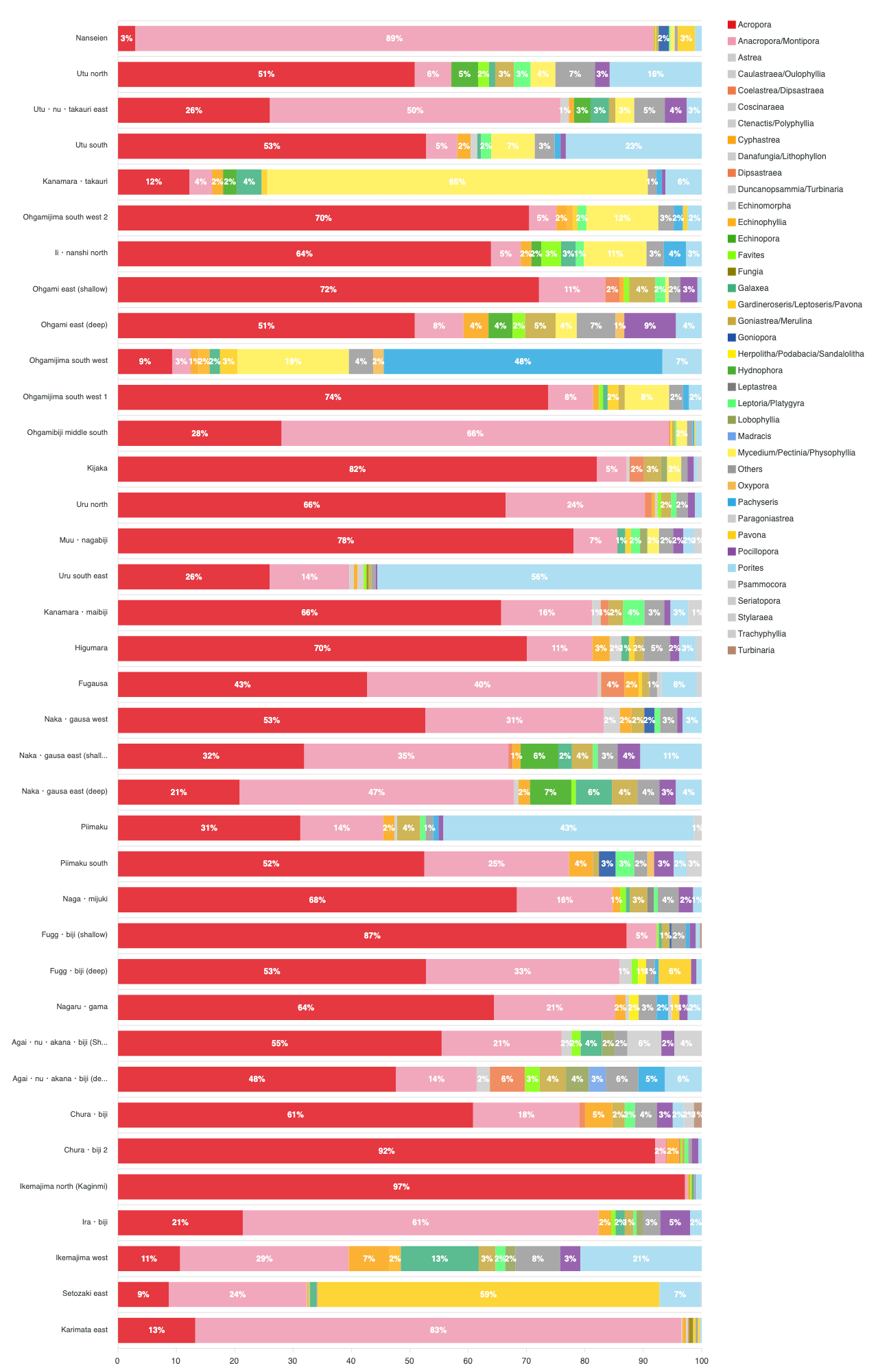
Environmental DNA (eDNA) surveys revealed that reefs in northern Miyako Island and the Yabiji Reef complex were dominated by sites where DNA of the genus Acropora was detected in high abundance. Although Acropora corals are particularly susceptible to bleaching caused by elevated seawater temperatures, they are also characterized by high dispersal ability and rapid growth rates. Coral communities in Yabiji and around Miyako Island suffered severe declines during the mass bleaching event of 2016. However, by 2023, the recovery of these reefs may have been facilitated by the recruitment and growth of Acropora corals. The eDNA results may therefore reflect this recovery process.
Interestingly, DNA of the genus Seriatopora, which is known to be sensitive to thermal stress, was detected more frequently around Ikema Island in northern Miyako Island than in Yabiji, where thermal stress during the 2016 bleaching event was particularly severe. This pattern may suggest that the reefs around Ikema Island function as a refugium for coral genera that are vulnerable to elevated temperatures.
Unfortunately, the coral reefs around Miyako Island suffered substantial damage once again during the large-scale bleaching event of 2024. Consequently, the eDNA data presented here provide a valuable record of the condition of Miyako Island’s coral reefs in 2023, immediately before the 2024 bleaching event occurred.


