Home > Mesophotic sea corals > Sesoko Island
The first experiment using an underwater drone equipped with a water-sampling device was conducted in the highly transparent waters of the Kerama Islands, where we were able to confirm the effectiveness of this approach (see "Mesophotic Reefs – Kerama Islands"). During that survey, video footage of the reef captured by the monitoring camera aboard the vessel allowed us to roughly infer the coral genera inhabiting the mesophotic reef where the drone was deployed. eDNA analyses subsequently identified coral genera. However, without reliable taxonomic identification of the corals present, there remained some uncertainty regarding the validity of this approach.
To address this issue, it was necessary to deploy the underwater drone at mesophotic reef sites where coral specialists had already confirmed and identified the resident coral populations through direct visual surveys, and then to verify that eDNA collected from those locations accurately reflected the same coral genera. Fortunately, a research team led by Dr. Saki Harii and Dr. Frederic Sinniger of the University of the Ryukyus maintained mesophotic coral research sites off Motobu, Okinawa Island. At the relatively shallow Shigeo Reef (~40 m depth), the genus Seriatopora was known to dominate, whereas at the deeper Shigeo Reef (~55 m depth), the genus Alveopora was dominant. With the cooperation of Drs. Harii and Sinniger, we conducted water-sampling surveys at these two mesophotic reefs on April 25, 2023.
The underwater drone used in this study was a FIFISH W6 Plus equipped with two water samplers, each capable of collecting 500 mL of seawater (Figure 1).
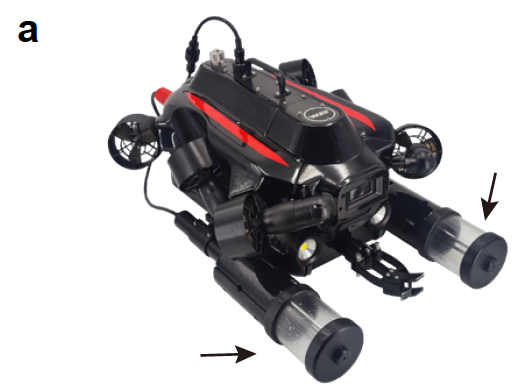
The underwater drone used in this study was a FIFISH W6 Plus equipped with two water-sampling devices (arrows).
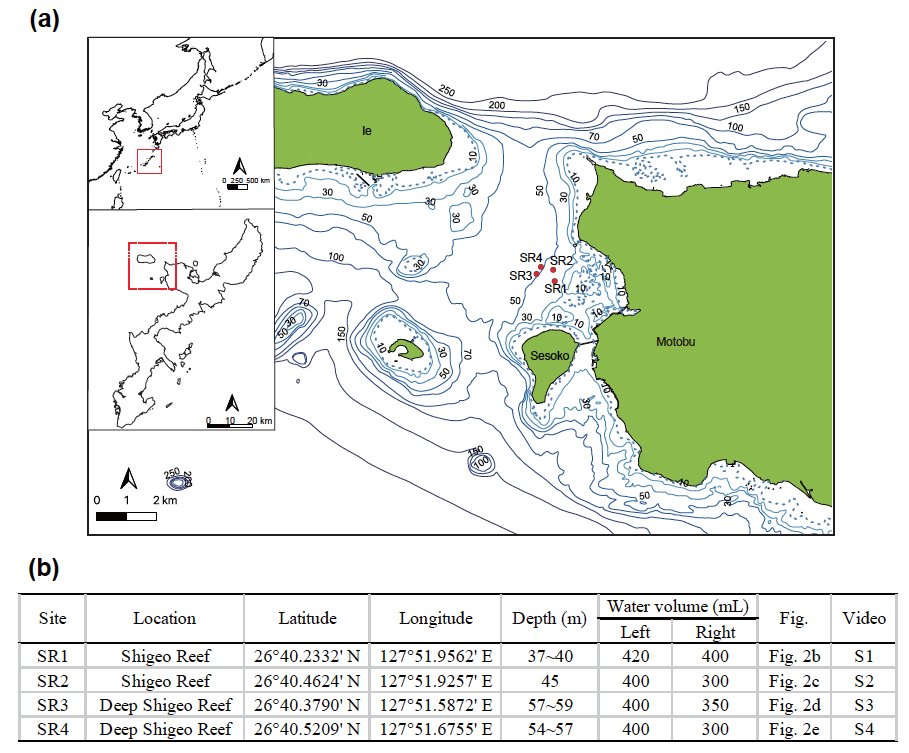
Shigeo mesophotic coral reef off Motobu, Okinawa Island, showing survey sites SR1–SR4.
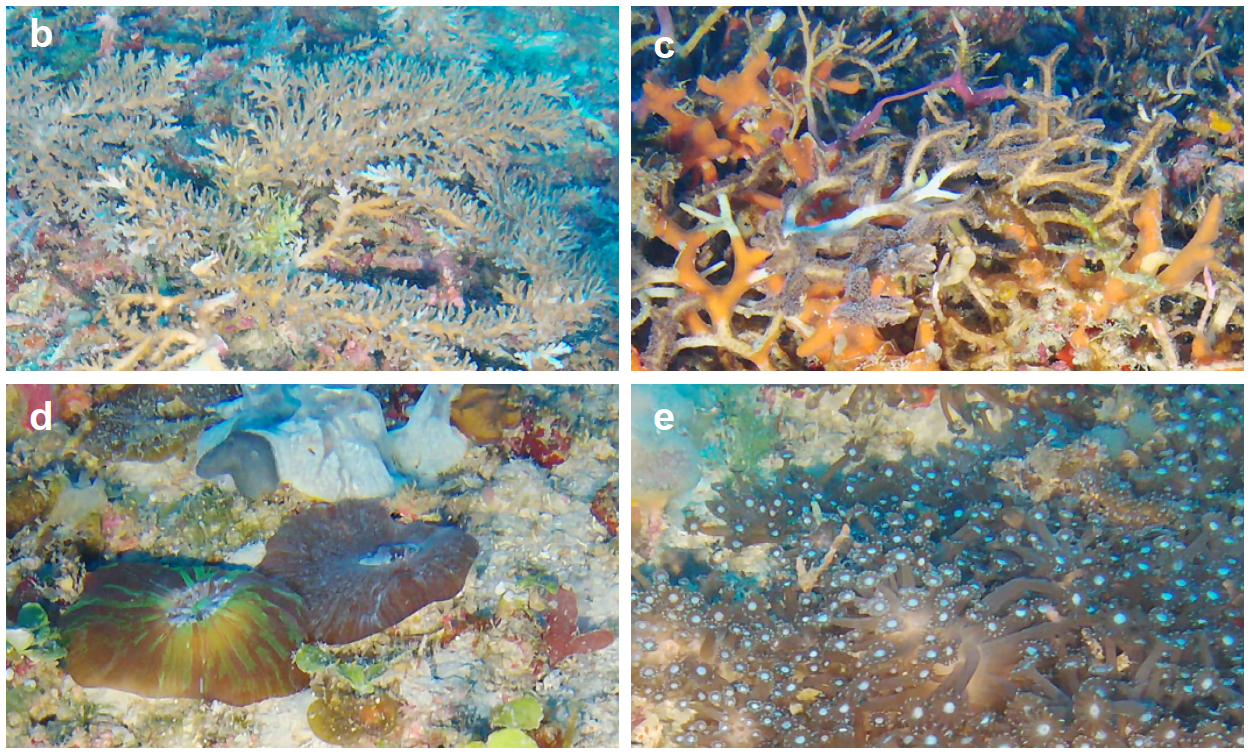
(b) Seriatopora dominates at Site SR2, whereas (e) Alveopora dominates at Site SR4.
| Point Number | Point Name | Latitude/Longitude | Sampling Depth | Dominant Genus | Percentage |
|---|---|---|---|---|---|
| SR1 |
Shigeo Reef 1

|
26.6705533, 127.8659367 | 40 m | Acropora (ミドリイシ属) | 88.16 % |
| SR2 |
Shigeo Reef 2
|
26.6743733, 127.8654283 | 45 m | Galaxea (アザミサンゴ属) | 45.02 % |
| SR3 |
Deep Shigeo Reef 3
|
26.6729833, 127.8597867 | 57 m | Anacropora (トゲミドリイシ属) / Montipora (コモンサンゴ属) | 26.8 % |
| SR4 |
Deep Shigeo Reef 4
|
26.6753483, 127.8612583 | 57 m | Alveopora (アワサンゴ属) | 49.95 % |

After several trial runs on the afternoon of April 25, 2023, we successfully deployed the underwater drone above the target sites, SR2 (Figs. 2 and 3c) and SR4 (Figs. 2 and 3e), and collected seawater samples.
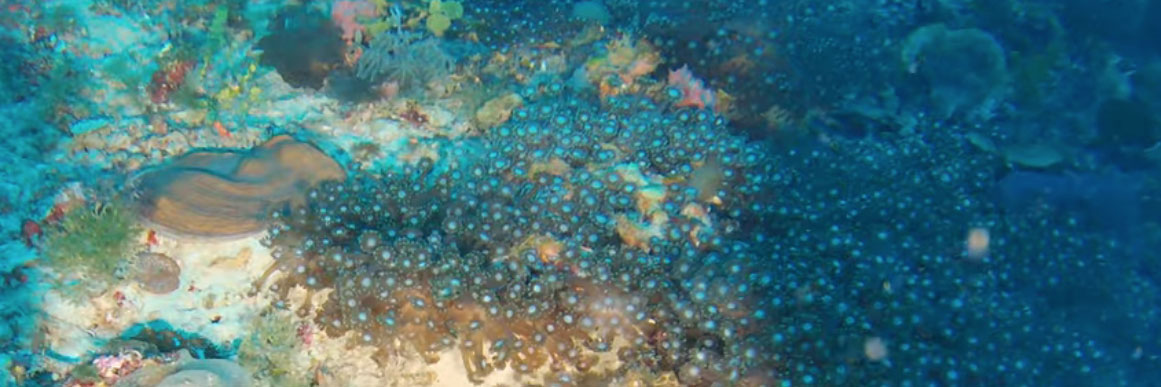
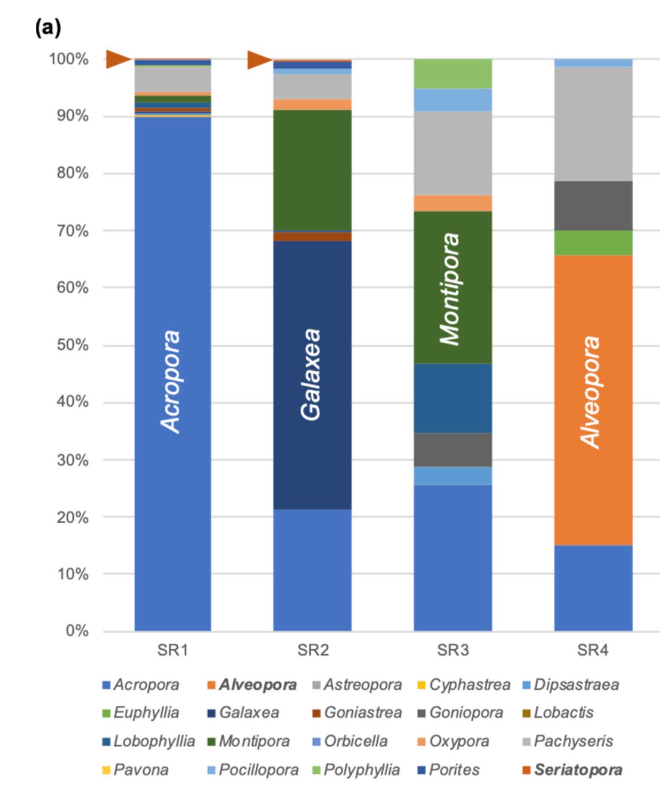
Analysis of the collected environmental DNA revealed that only the SR4 site (see video above) yielded a dominant abundance of ZOTUs corresponding to Alveopora (Figs. 4 and 5). In contrast, ZOTUs corresponding to Seriatopora were detected in large numbers at SR2 and in moderate numbers at SR1, but were not detected at the SR3 and SR4 sites.
These results demonstrate the validity of our underwater drone-based environmental DNA detection and identification approach and provide a foundation for future eDNA surveys of mesophotic coral reefs using underwater drones.


